
Dog enrichment basics: easy ideas for everyday life
"Enrichment" sounds like a luxury extra, but it is closer to a basic need. It simply means giving your dog everyday chances to do the things dogs are built to do — sniff, forage, lick, chew, explore new things, and make small choices of their own. A dog with those outlets is usually easier to live with. A dog without them invents their own — shredding the post, excavating the sofa — and their inventions are rarely the ones we would choose.
This page is the starting point for our enrichment guides. It covers what enrichment actually means, why it supports calm behaviour, how mental work differs from physical exercise, and where to begin — with a link to a step-by-step guide for each idea. As with everything on this site, it is written for ordinary, healthy dogs and everyday behaviour: if your dog's restlessness comes with panic when left alone, aggression, or a sudden change in character, start with dog behaviour red flags instead, because that is not a boredom problem.
The quick answer
Enrichment means giving your dog safe outlets for natural behaviours — sniffing, licking, chewing, foraging and problem-solving — so their mind gets a workout, not just their body. Most dogs are noticeably calmer for it.
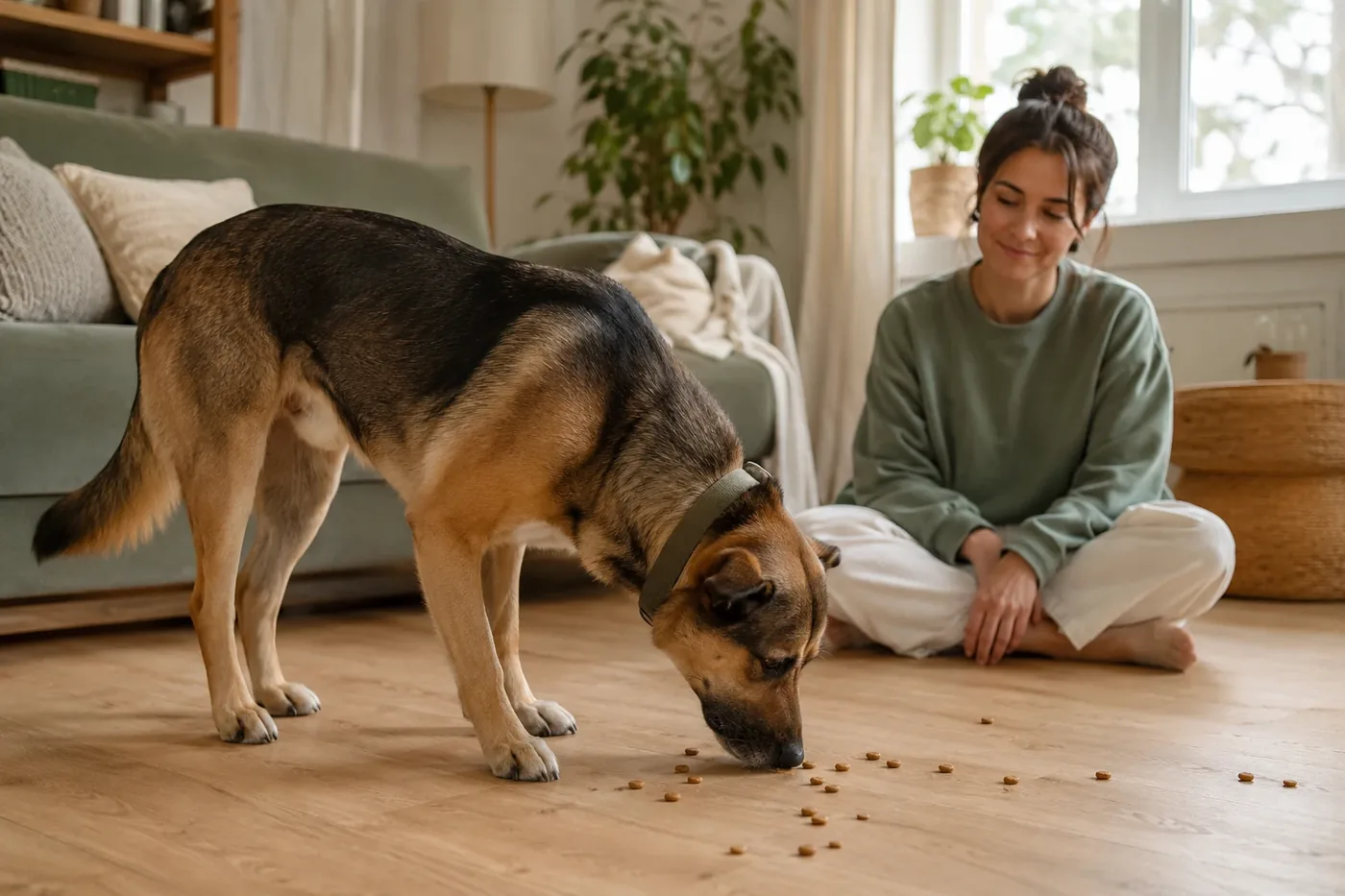
- Start with food: scatter part of a meal in the grass or a towel, or use a lick mat or a stuffed food toy.
- Add sniffing: let your dog choose the route and sniff freely on one walk a day.
- Rotate a few simple activities rather than buying lots of gear.
- Keep it short: a few brief sessions beat one long one — stop while your dog is still enjoying it.
Safety note
This article is educational only. It is not veterinary advice, a diagnosis, or an individualised training plan.
Enrichment is for everyday needs — the healthy dog who is a bit bored or under-occupied. It is not a treatment for distress. A dog who panics when left alone, destroys things frantically rather than playfully, suddenly stops settling, or shows fear, aggression, or ongoing distress may need a veterinarian, a certified positive-reinforcement trainer, a certified behaviour consultant, or a veterinary behaviour professional. The warning signs worth knowing are collected in dog behaviour red flags. No amount of food puzzles should be used to paper over a dog who is struggling.
What enrichment actually means
Strip away the jargon and enrichment is just natural behaviour with somewhere to go. Most family dogs live in homes that are safe, warm, and comfortable but short on things to do, and the behaviours below are the ones they most often go without.
- Sniffing. Smell is a dog's primary sense. A walk where the dog is allowed to read every lamppost is a completely different experience from a brisk march at heel.
- Foraging. Dogs are natural scavengers, wired to search for food. A bowl emptied in forty seconds skips the part many dogs enjoy most: the finding.
- Licking and chewing. Slow, rhythmic activities that many dogs find genuinely soothing — closer to a quiet hobby than a game.
- Novelty. New objects, surfaces, smells, and routes give the brain something fresh to process, in small and always optional doses.
- Choice. Deciding which way to turn, what to investigate, and when to stop. Small choices matter to an animal whose day is otherwise decided entirely by us.
None of this needs special equipment. A cardboard box, a rolled towel with food tucked in the folds, a handful of kibble scattered across the grass — most of the best enrichment is free.
Why meeting these needs supports calm behaviour
It can sound backwards: give the dog more to do and they become calmer? For many dogs, yes. Sniffing, licking, chewing, and foraging are not just entertainment — they are naturally settling activities that tend to wind a dog down rather than up.
A dog whose needs are met also has less unspent motivation looking for an exit. The pacing, mouthing, shadowing, and persistent attention-seeking often shrink once a dog has had legitimate outlets earlier in the day.
Enrichment works best alongside teaching, not instead of it. A dog also needs to learn that resting is worthwhile — that is the job of teaching a calm settle — and it is far easier to provide enrichment consistently when it has a fixed place in a simple daily routine.
Exercise for the body is not work for the mind
Physical exercise matters, but it answers a different need. A long run tires muscles; it does not give the nose or the brain much to do. Some dogs even come home from fast, high-arousal exercise — endless ball-chasing is the classic example — more wound up than when they left.
Mental work is different. Ten minutes of hunting for scattered food can leave many dogs more genuinely finished than a brisk half hour on pavement, because searching, sniffing, and problem-solving are effortful in a way that trotting is not. If a walk is off the table entirely one day, there are plenty of ways to tire out a dog without a walk.
Most dogs need some of both — and in most households it is the mental half that goes missing.
How much is enough?
There is no correct daily dose, so be wary of anyone who offers one. The honest answer is: watch your dog. A dog who finishes a food game still curious, settles afterwards, and greets the next session keenly is getting roughly the right amount. A dog who is frantic, frustrated, or ignores the game needs something easier, shorter, or different.
A few caveats shape what "enough" looks like:
- Puppies do best with tiny, easy sessions — a minute of scatter-fed kibble beats a puzzle they cannot solve.
- Older dogs often adore sniffing games, which are kind to stiff bodies; keep search areas small and floors non-slip.
- Hot or foul weather is a good reason to swap a walk for indoor foraging rather than pushing on regardless.
- Health and diet: use part of your dog's normal daily food for enrichment rather than adding extras, and if your dog's weight or diet is being managed — or you are unsure what is safe to use in food games — ask your vet first.
Little and often beats marathons: a few five-minute activities spread across the day suit many dogs better than one long session that tips into frustration.
Quick-start ideas by category
Each idea below has its own step-by-step guide, so you can start with whichever fits your dog and your week.
Sniffing and foraging
The easiest entry point of all: scatter a portion of your dog's food across the lawn or a towel and let them hunt. Our guide to a DIY snuffle mat and scatter feeding shows how to build up from there. On walks, let the nose lead — we call these sniffari walks, and they can make even a short outing satisfying.
Food puzzles and slower meals
A food-dispensing toy turns dinner into a small project. The trick is starting easy, so the game builds confidence instead of frustration — our guide to introducing a puzzle feeder walks through it gradually.
Games for stuck-indoors days
Rain, heat, or a quiet day at home are no barrier. Try our rainy-day indoor dog games — simple search and foraging games that need nothing more than a hallway and a handful of food.
Calm things to do home alone
Safe, low-effort setups can help a contented dog pass a stretch on their own — see enrichment for a dog home alone. One caveat: if leaving triggers howling, drooling, or destruction at doors and exits, that is separation-related distress, not boredom, and it needs qualified help rather than a food toy.
When it is not boredom
Enrichment is popular advice, and its popularity has a downside: it can quietly delay real help. If a dog who used to settle has stopped settling, if restlessness arrived suddenly, or if it comes with night-time pacing, appetite changes, or a new reluctance to be touched, think health first and puzzles second. The patterns to look for are described in signs of pain in dogs and sudden dog behaviour change.
The same goes for distress. Panic when alone, aggression toward people or dogs, and guarding that is getting worse are not under-stimulation problems, and no enrichment plan treats them. Start with dog behaviour red flags and get in-person, qualified support.
What not to do
Do not:
- punish restlessness — barking, pacing, and chewing are information about unmet needs (or something more serious), not defiance
- reach for shock, prong, or choke collars, leash corrections, spray bottles, shake cans, or "alpha" and dominance methods — suppressing a behaviour does nothing for the need underneath it
- leave a dog unsupervised with anything they could swallow — toy parts, string, fabric, or chews that splinter; supervise new items first
- start with the hardest puzzle — a dog who cannot win gives up or gets frustrated, so make the first version almost embarrassingly easy
- force a hesitant dog to engage with a new object — novelty should always be optional, at the dog's own pace
- treat enrichment as a substitute for company, exercise, training, or veterinary care — it is one ingredient, not the whole meal
How this connects to other pages
This page is the hub of our enrichment cluster: the guides linked above each take one idea and turn it into steps you can follow this week. It also has hands-on guides for the everyday gear that makes enrichment easy — lick mats, safe chews, stuffed food toys, and long lines for sniffing and recall. Enrichment pairs naturally with teaching your dog to settle calmly — outlets first, rest second — and slots most easily into a simple daily training routine. The reward-based, no-force approach underneath everything here is explained in humane dog-training principles.
Common questions
What is enrichment for dogs?
Enrichment is any safe activity that lets a dog use natural behaviours — sniffing, foraging, licking, chewing and problem-solving. It gives the mind a job, which tends to leave dogs calmer and more settled than physical exercise alone.
How much enrichment does a dog need each day?
For most healthy adult dogs, a few short sessions — a scattered meal, a lick mat and one sniff-led walk — is plenty. Variety matters more than duration, and it is fine to stop while your dog is still keen. Puppies and older dogs need gentler, shorter sessions.
Can enrichment help with problem behaviour?
Enrichment can take the edge off boredom-related habits like chewing, pacing or attention-seeking, because it meets needs that would otherwise spill out. But a sudden change in behaviour, or genuine anxiety, fear or aggression, is not a boredom problem — read our dog behaviour red flags and speak to a vet or qualified behaviourist.
Is mental exercise as tiring as a walk?
Sniffing and problem-solving are genuinely tiring for dogs and can settle them on days a long walk is not possible. They work best alongside daily movement rather than fully replacing it, but on a rest day gentle enrichment is a good stand-in.
Educational disclaimer
The information on this page is provided for general educational purposes only. It is not veterinary advice, a behavioural diagnosis, or an individualised training programme, and nothing here has been personally tested on or guaranteed for your dog. Every dog is different, and what suits one may not suit another.
If you have any concern about your dog's health, comfort, or behaviour — especially sudden restlessness, distress when left alone, or any sign of pain — please consult a veterinarian, a certified positive-reinforcement trainer, a certified behaviour consultant, or a veterinary behaviour professional. When in doubt, get qualified support before changing anything.
Sources and further reading
These sources support the enrichment ideas and welfare boundaries used on this page. This page is educational only and is not a substitute for veterinary or qualified behaviour support.