
How to tire out a dog without a walk
Some days the walk just is not going to happen. The rain is sideways, the pavement is icy or scorching, your schedule has collapsed, or your vet has asked you to keep your dog quiet while something heals.
The good news is that a dog's brain burns energy too. Ten minutes of sniffing, searching, and puzzling over food can leave many dogs calmer and more satisfied than you might expect, and this page collects gentle, reward-based ways to do it — building on the thinking in dog enrichment basics.
This guide is for ordinary, healthy dogs on the occasional walk-free day. If your dog suddenly cannot settle no matter what you offer, or seems unusually flat and uninterested in everything, that is a different situation — start with dog behaviour red flags instead.
Safety note
This article is educational only. It is not veterinary advice, a diagnosis, or an individualised training plan.
The ideas here are for everyday situations: bad weather, busy days, and quiet days your vet has asked for. If your dog is recovering from illness, injury, or surgery, ask your vet which activities are appropriate before trying any of them — even gentle games involve movement. And if your dog seems unable to settle day after day, becomes frantic, or loses interest in food and games, that pattern can point to discomfort rather than boredom: see signs of pain in dogs and sudden dog behaviour change. A sudden behaviour change, severe fear, panic, aggression, or ongoing distress may need a veterinarian, a certified positive-reinforcement trainer, a certified behaviour consultant, or a veterinary behaviour professional.
Why mental work tires dogs out
Physical exercise is only one way a dog spends energy. Sniffing, searching, and working out small problems take real effort, and welfare organisations are clear that mental exercise can be just as tiring as physical exercise for many dogs.
Scent work is especially effective. A dog's nose is their primary sense, and food-searching games tap into natural foraging behaviour — the kind of work dogs were doing long before pavements existed. Research summarised by the RSPCA suggests that scent-based enrichment can increase engagement and the time dogs spend resting afterwards.
The tiredness you are aiming for is the good kind: a dog who finishes a search, has a drink, and flops down with a sigh. It is not the wired, panting exhaustion that comes from being run ragged — more on that later.
When a walk-free day makes sense
Skipping the walk is a sensible choice on some days, not a failure:
- Weather: heat, ice, storms, or anything else that makes walking unpleasant or unsafe for paws and lungs
- Recovery days: when your vet has asked you to restrict exercise — always check with them which quiet games are appropriate while your dog heals
- Busy or disrupted days: sometimes life simply gets in the way, and a rich indoor day beats a rushed, stressful outing
What this page is not: a permanent replacement for walks. Most dogs need regular time outdoors to sniff, explore, toilet comfortably, and experience the world. When normal service resumes, a slow, sniff-led outing — a sniffari walk — is a lovely way back in.
Scatter feeding and find-it games
The easiest place to start is your dog's own food. Instead of putting the bowl down, make the meal a search.
Scatter feeding
Toss a portion of your dog's meal across the kitchen floor, a rug, or a spread-out towel and let them hoover it up nose-first. It costs nothing, takes seconds to set up, and turns a thirty-second meal into ten minutes of focused sniffing.
A snuffle mat — a fabric mat with folds that hide food — slows things down further. Our DIY snuffle mat and scatter feeding guide walks through making one from things you already own and building up the difficulty gently.
The find-it game
Show your dog a treat, say a cheerful "find it," and toss it a metre away where they can see it land. Once they know the game, start placing treats around the room while they wait elsewhere, then invite them in to search.
Keep hiding spots at nose level and easy at first — behind a chair leg, beside a cushion. The goal is lots of quick wins, not a frustrating puzzle.
Short training bursts
Two or three minutes of reward-based training uses a surprising amount of mental fuel. Run through cues your dog already knows, then spend a minute on one easy new thing — a hand touch, a spin, stepping onto a mat.
Keep sessions short and stop while your dog is still keen. Several tiny sessions spread through the day beat one long one, and the treats can come straight out of the day's food allowance. If you would like a ready-made structure, see our simple daily dog training routine.
Indoor sniffing games beyond mealtime
Once your dog loves searching, you can build bigger games from household bits and pieces:
- Box search: stand a few open cardboard boxes around the room and drop treats into one or two. Let your dog work out which.
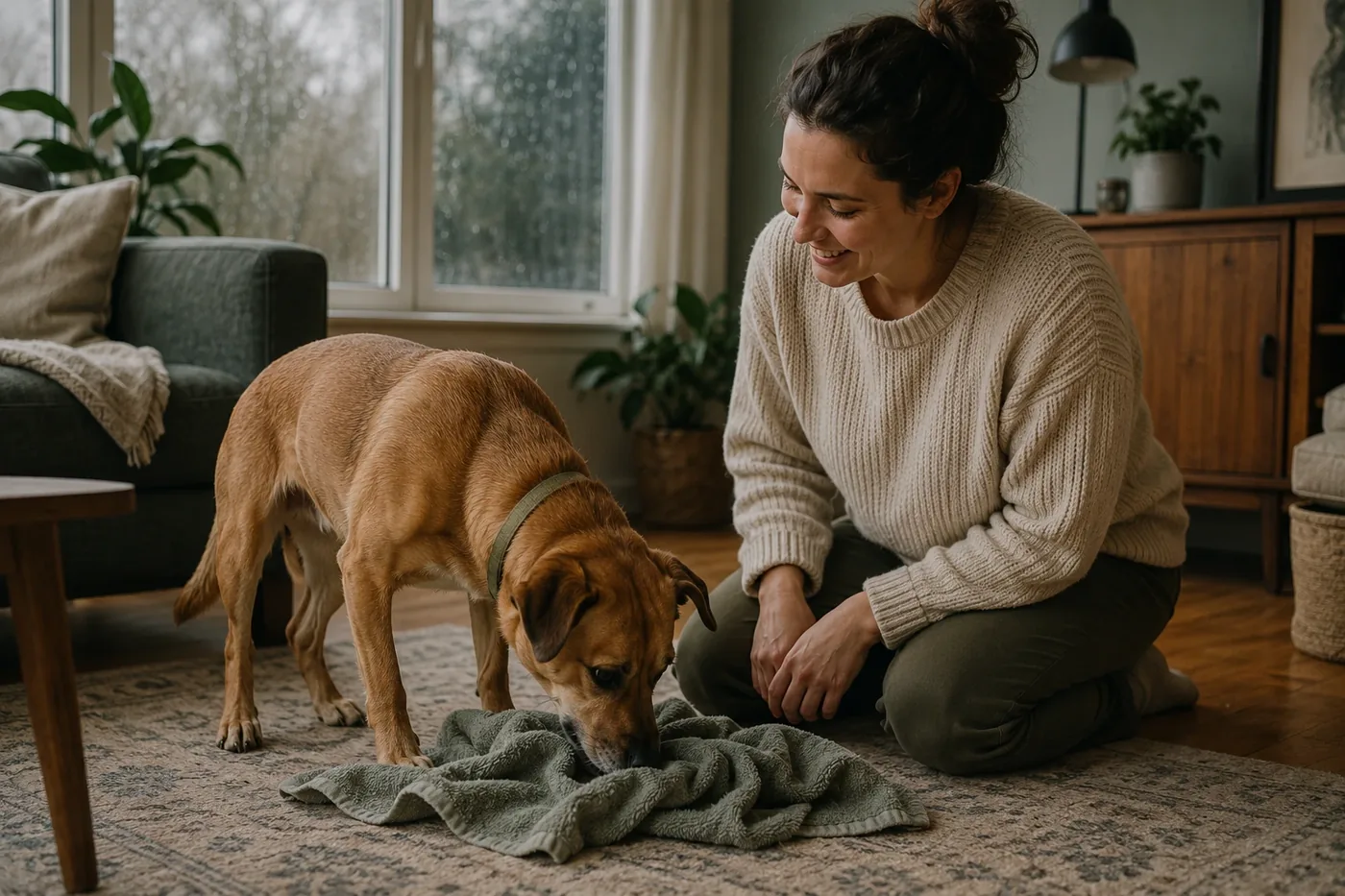
- Towel roll-up: sprinkle kibble along a towel, roll it loosely, and let your dog unroll it with nose and paws.
- Cup shuffle: hide a treat under one of two or three sturdy cups and let your dog nudge the right one over.
- Room-to-room search: hide a favourite toy or a few treats in another room and send your dog off to find them.
For a fuller menu of wet-afternoon ideas, our rainy-day indoor dog games page has plenty more.
Licking and chewing to wind down
Not all tiring activity is busy. Long, slow licking and chewing help many dogs decompress — they are calming, repetitive behaviours that dogs often settle into naturally after activity.
A lick mat spread with a thin layer of soft, dog-safe food, a stuffed food-dispensing toy, or a long-lasting chew can occupy a dog for a peaceful stretch. Offer them after a game, when your dog is ready to slow down rather than ramp up.
Supervise chewing, choose items suited to your dog's size and chewing style, and ask your vet if you are unsure what is safe for your individual dog. If food puzzles are new to your dog, start easy — our guide to introducing a puzzle feeder shows how to build confidence rather than frustration.
Rest matters: do not fill every hour
A common trap on indoor days is trying to entertain the dog constantly. Overtired dogs do not act tired — they get frantic. Zoomies, mouthing, pestering, and an inability to settle are often signs a dog needs less stimulation, not more.
Adult dogs rest for much of the day, and puppies need even more sleep. A good walk-free day looks like a few short activities — a scatter feed here, a training burst there, a chew in the evening — separated by long, boring stretches of nothing.
If your dog struggles to switch off between activities, teaching a relaxed settle is one of the kindest skills you can give them. Our guide to teaching a dog to settle calmly covers it step by step.
What not to do
Do not:
- play endless fetch until your dog is exhausted — repetitive, high-arousal chasing tends to wind dogs up rather than wear them out, and it is hard on joints
- use laser pointers — there is nothing to catch, and the frustration can tip some dogs into obsessive light- and shadow-chasing
- force games on a dog who is not interested, or flood a worried dog with constant activity in the hope of tiring them into calm
- use shock, prong, or choke collars, leash corrections, spray bottles, or any "alpha" or dominance methods — they have no place in play or training
- make every single meal hard work — if your dog finds a puzzle stressful, make it easier or go back to simple scatter feeding
- treat indoor games as a permanent substitute for walks, outdoor sniffing, and time in the world
- ignore a dog who suddenly cannot settle at all, or who goes unusually flat and uninterested — check dog behaviour red flags and speak to your vet
How this connects to other pages
This page is a practical branch of dog enrichment basics, which explains the thinking behind all of these games. For step-by-step food-search setups, see DIY snuffle mats and scatter feeding; for a longer list of indoor games, try rainy-day indoor dog games. And because rest is half the picture, teaching your dog to settle calmly ties the whole day together.
Educational disclaimer
The information on this page is provided for general educational purposes only. It is not veterinary advice, a behavioural diagnosis, or an individualised training programme, and nothing here has been personally tested on or guaranteed for your dog. Every dog is different, and what suits one may not suit another.
If you have any concern about your dog's health, comfort, or behaviour — especially a sudden change in energy, restlessness that will not ease, or loss of interest in food and play — please consult a veterinarian, a certified positive-reinforcement trainer, a certified behaviour consultant, or a veterinary behaviour professional. When in doubt, slow down and get qualified support.
Sources and further reading
These sources support the enrichment and humane-training boundaries used on this page. This page is educational only and is not a substitute for veterinary or qualified behaviour support.