How to introduce a puzzle feeder to your dog
A puzzle feeder is any toy or surface that asks your dog to work a little for their food — nosing a ball to release kibble, licking soft food from a textured surface, or flipping open small compartments to find what is hidden inside. Dogs are natural scavengers, and many of them genuinely enjoy this kind of gentle problem-solving far more than eating from a bowl.
The catch is that a puzzle feeder only helps if your dog understands it and wins at it. Introduced too fast, the same toy that should build confidence can teach a dog that food games are frustrating and not worth the effort. This guide walks through a kind, gradual introduction that sets your dog up to succeed from the first sniff.
It covers everyday enrichment for ordinary, relaxed dogs, and it sits alongside our wider guide to dog enrichment basics. If your dog guards food or toys, or their behaviour has changed suddenly, please start with dog behaviour red flags instead.
Safety note
This article is educational only. It is not veterinary advice, a diagnosis, or an individualised training plan.
Puzzle feeders are an everyday enrichment tool for relaxed, healthy dogs. If your dog stiffens, freezes, hovers over the toy, growls, or snaps when anyone comes near their food, stop using food puzzles and seek qualified help — pushing through guarding tends to make it worse, not better. A sudden change in appetite or behaviour, signs of pain, severe fear, panic, aggression, or ongoing distress may need a veterinarian, a certified positive-reinforcement trainer, a certified behaviour consultant, or a veterinary behaviour professional. The wider warning signs are described in dog behaviour red flags, signs of pain in dogs, and sudden dog behaviour change.
Start easier than you think
If you remember one thing from this page, make it this: your dog must win, fast. The first few times your dog meets a puzzle feeder, the food should practically fall out on its own. A dog who gets paid within seconds learns that this odd new object is a food machine worth investigating.
A dog who struggles learns something too — that the object is pointless — and some dogs write a toy off after one bad session. So start easier than feels sensible: openings on their widest setting, lids left off, compartments already half open, and a few treats scattered loose around the toy so the very first sniff pays. You can always make the game harder later.
Common types of puzzle feeder
You do not need anything fancy, and no single type suits every dog. Described generically, the main families are:
- Food-dispensing balls and tumblers: hollow toys that drop kibble as your dog nudges and rolls them. Most have an adjustable opening — begin on the easiest setting.
- Lick surfaces: textured mats or plates you smear soft food onto. Slow, repetitive licking is calming for many dogs, and these are the gentlest possible starting point.
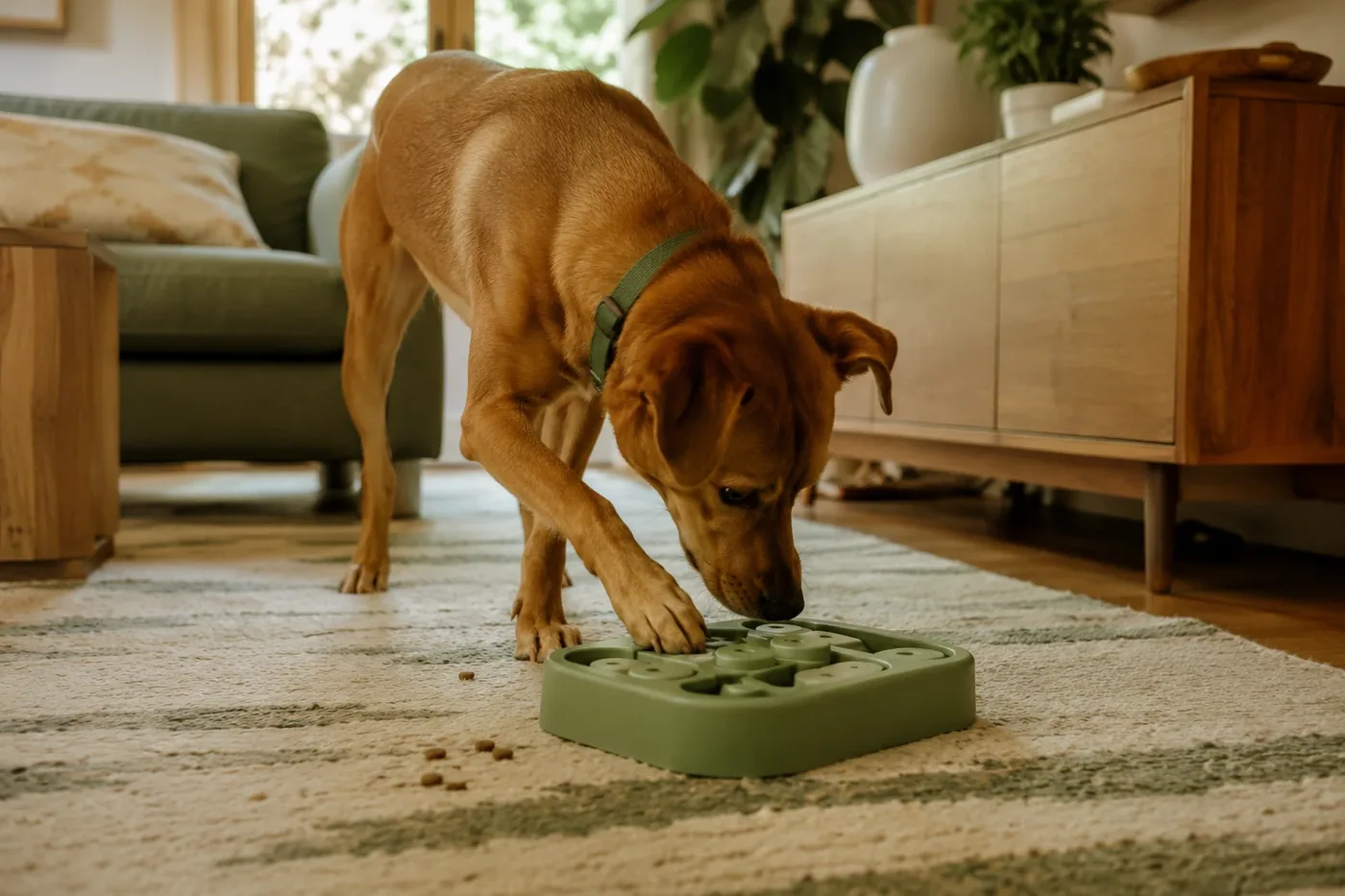
- Hide-compartment boards: flat puzzles with sliders, flaps, or cones that your dog nudges or lifts to reveal treats. Best used together, as a supervised game.
- Hollow stuffable toys: rubber toys you fill loosely with food. Loosely at first — tightly packed or frozen versions are an advanced level, not a beginning.
- Homemade versions: a towel with kibble rolled inside, or food hidden through scrunched paper in a box — our DIY snuffle mat and scatter feeding guide covers these in detail.
Whatever you choose, pick a size that suits your dog: pieces small enough to fit entirely in the mouth can be swallowed, and flimsy toys can be chewed apart by a strong-jawed dog. Sturdy, size-appropriate, and simple beats clever.
A kind first session
Step 1: let the food do the introducing
Choose a quiet moment when your dog is interested in food but not desperately hungry. Load the feeder with something smelly and easy to love, set it on the floor, and scatter two or three extra treats right beside it. Then step back and let your dog explore at their own pace — no pointing, no pushing the toy at them.
Step 2: keep it short and end on a win
A minute or two is plenty for a first session. Quit while your dog is still succeeding and still keen — that lingering wish for more is what brings them back to the toy with enthusiasm tomorrow.
Step 3: raise the difficulty one notch at a time
Only make the game harder after several sessions of easy, happy wins: narrow the opening slightly, close one compartment, pack the stuffable toy a little fuller. If a new level stumps your dog, drop straight back to the level they were winning at.
Watch for frustration, not just success
Frustration is the main way puzzle feeders go wrong, and dogs tell you about it clearly if you watch. Common signs include:
- walking away from the toy and not coming back
- barking or whining at the feeder
- pawing or biting at it frantically rather than working it methodically
- chewing the toy itself instead of trying to get the food out
- looking back at you repeatedly with a tense, stuck expression
None of this is stubbornness or laziness. It is information: the game is too hard for where your dog is right now. Make it easier immediately — open it up, tip some food out, scatter a few freebies — and let your dog finish on a success.
A dog who quits is not failing the puzzle. The puzzle is failing the dog.
Feeding meals through puzzle feeders
Once your dog reliably enjoys a feeder, you can start serving part of their ordinary meals through it. Begin small: a spoonful or a handful in the puzzle, the rest in the bowl as usual. Over a week or two, shift more across if your dog stays relaxed and keen.
There is no rule that every meal must be worked for. Many households settle on one puzzle meal a day, or a few each week, with normal bowl meals in between. Variety is the point, not effort for its own sake.
Food in puzzles is still food — count it as part of the daily ration rather than adding it on top, and ask your vet if you are unsure about amounts or if your dog's appetite changes. And slow, sniffy, licky eating tends to leave many dogs calmer afterwards, which connects to the wider picture in the dog gut-brain connection.
Supervision, sizing, and upkeep
Supervise new feeders
Stay nearby whenever your dog uses a feeder they have not fully proven themselves with — you want to see how they handle it and step in cheerfully if it beats them. Check toys regularly and retire anything cracked, splintered, or losing chunks. Only a feeder your dog has used calmly and safely many times should ever be part of an unsupervised setup, such as the routines in home-alone enrichment.
Puppies and senior dogs
Puppies can absolutely enjoy puzzle feeders — keep versions extremely easy, treats soft and small, sessions very short, and supervision constant, because everything goes in a puppy's mouth. Senior dogs often love lick surfaces and gentle scent-based puzzles; work on a non-slip surface, and mention it to your vet if a previously keen puzzle-solver suddenly struggles or loses interest, since that can hint at discomfort.
Keep it clean
Anything that holds wet or smearable food needs washing after each use — warm soapy water, a good rinse, and a full air-dry, paying attention to crevices where residue hides. Dry kibble toys need less fuss, but a regular wash keeps them pleasant to use and worth sniffing.
What not to do
Do not:
- start on a hard setting, or skip meals so your dog is "hungry enough to try" — hunger plus an impossible puzzle equals pure frustration
- hold the feeder, wiggle it at your dog, or repeatedly take it away to "reset" it while they are working
- scold a dog who gives up, barks at the toy, or chews it — make the game easier instead
- use food puzzles to push through guarding; stiffening, freezing, or growling over food needs qualified help, not more practice
- leave a brand-new feeder, or anything with small or damaged parts, with an unsupervised dog
- use shock, prong, or choke collars, leash corrections, or any dominance-based handling around food — nothing about mealtimes needs pressure
- forget that puzzle food counts toward the daily ration — quiet weight gain is the most common side effect of enthusiastic enrichment
How this connects to other pages
Puzzle feeders are one branch of a much bigger enrichment picture, and dog enrichment basics explains how the branches fit together. If you would rather start with household items than bought toys, the DIY snuffle mat and scatter feeding guide covers the homemade route. Once a feeder is a proven favourite, it becomes one of the most useful tools in home-alone enrichment, and the calm that slow, sniffy eating produces ties into the dog gut-brain connection.
Educational disclaimer
The information on this page is provided for general educational purposes only. It is not veterinary advice, a behavioural diagnosis, or an individualised training programme, and nothing here has been personally tested on or guaranteed for your dog. Every dog is different, and what suits one may not suit another.
If you have any concern about your dog's health, appetite, weight, or behaviour — especially guarding, frustration that does not ease, or a sudden change around food — please consult a veterinarian, a certified positive-reinforcement trainer, a certified behaviour consultant, or a veterinary behaviour professional. When in doubt, put the puzzle away, feed normally, and get qualified support.
Sources and further reading
These sources support the humane-training and welfare boundaries used on this page. This page is educational only and is not a substitute for veterinary or qualified behaviour support.