
Loose-Leash Walking Without Leash Corrections
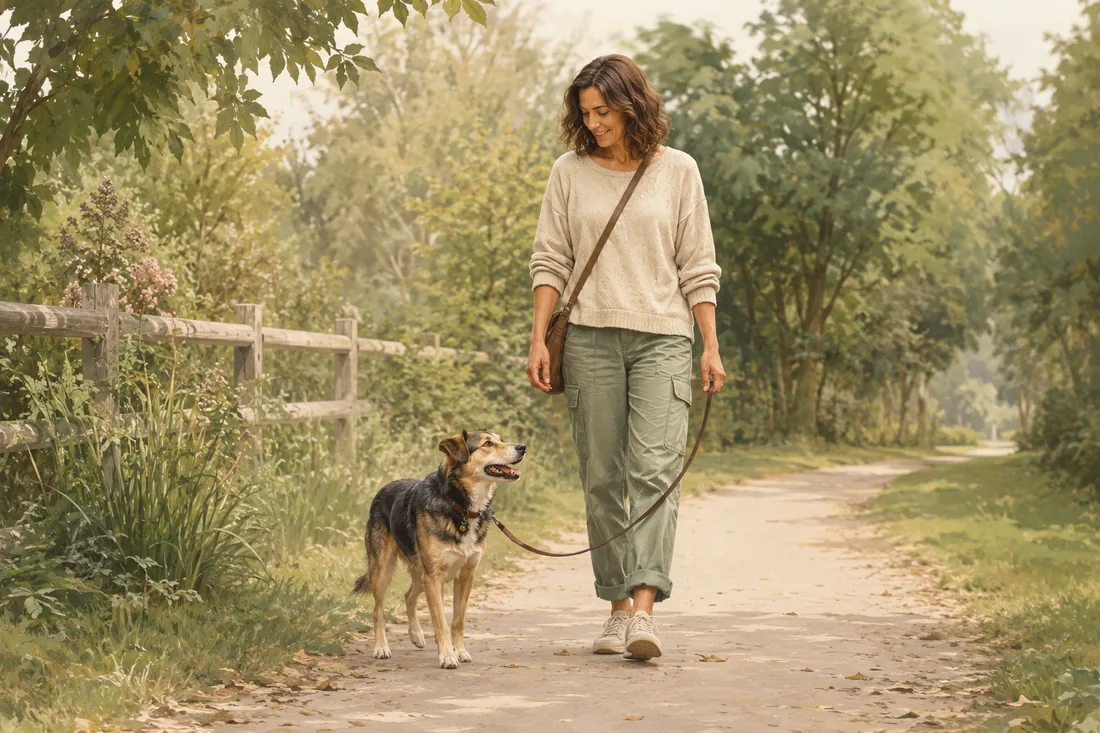
Loose-leash walking means the dog can walk with the lead relaxed instead of pulling hard toward every smell, person, or interesting thing.
It does not mean the dog must march beside the owner like a robot.
For ordinary everyday walks, the goal is simple:
The lead stays loose, the dog can sniff appropriately, and the owner and dog can move together without force.
This guide is for ordinary pulling only.
It is not for dogs who lunge aggressively, panic outside, bark and cannot recover, threaten people or animals, or become unsafe on walks. If those issues are present, read Dog behavior red flags and when to get professional help before using this guide.
For the site’s training approach, read Humane dog-training principles. For the site’s limits, read What this dog-training site covers.
The quick answer
You can teach loose-leash walking without leash pops, prong collars, or punishment by rewarding the dog whenever the lead goes slack. Kind Dog Guide’s WALK framework keeps it simple: Work in an easy place, Allow sniffing as a reward, Looseness makes movement happen, Keep sessions short. When the dog pulls, stop calmly and wait for slack before moving on.
- Start somewhere easy: a hallway, garden, or quiet path where the dog can still notice you and take rewards.
- Make sniffing the reward: a couple of loose steps earns a cheerful “yes” and a short sniff break at a safe spot.
- When pulling starts, stop calmly, wait for the leash to loosen, reward, and move forward again — never yank or jerk the lead.
- Keep sessions short: five loose steps or one quiet minute counts; a walk can mix practice with ordinary sniffing time.
Safety note
This article is for everyday, non-dangerous training only. It should not delay veterinary care or qualified behavior support when health, pain, injury, sudden change, bite risk, severe fear, panic, separation-related distress, or dangerous behavior is present.
This page is educational only. It is not veterinary advice, a diagnosis, or an individualized training plan.
If pulling is sudden, intense, linked with pain or mobility changes, paired with fear, threats, lunging, severe barking, or dangerous behavior, this article is not enough.
Practice only where the owner can stay safe and avoid roads, crowds, uncontrolled dogs, and hazards.
What this page rejects
This page does not recommend:
- leash pops
- leash corrections
- yanking
- jerking
- dragging
- prong collars
- choke chains
- shock collars
- intimidation
- dominance or alpha explanations
- punishing the dog for pulling.
Ordinary pulling usually does not need a dominance explanation. It often happens because the dog naturally moves faster than humans, wants to sniff, has learned that pulling works, or is too excited for the environment.
The reward-based plan is to teach the dog that a loose leash makes forward movement, safe sniffing, and rewards more available.
When this guide is a good fit
This guide may help if the dog:
- pulls toward smells
- pulls at the start of a walk
- zigzags mildly
- forgets the owner exists outside
- pulls because the environment is exciting
- can still eat, respond, recover, and move safely.
This guide is not enough if the dog:
- lunges dangerously
- threatens people or animals
- has bitten or may bite
- panics outdoors
- freezes and cannot move
- cannot recover after seeing triggers
- pulls suddenly after a change in health or movement
- is too strong for the owner to manage safely.
The WALK framework
Use the WALK framework:
- W — Work in an easy place
- A — Allow sniffing as a reward
- L — Looseness makes movement happen
- K — Keep sessions short
W — Work in an easy place
Do not start on the busiest street.
Start somewhere easy:
- hallway
- quiet room
- garden
- driveway
- quiet pavement away from traffic, hazards, crowds, and uncontrolled dogs
- low-distraction path.
The dog should be able to notice the owner and take rewards.
If the dog cannot eat, look back, or respond at all, the environment is too hard or the dog may be too stressed.
A — Allow sniffing as a reward
Sniffing is important to many dogs.
Loose-leash walking does not mean “no sniffing.”
Instead, use sniffing as part of the reward system.
Example:
Dog walks with a loose leash for one or two steps.
Owner marks the moment with “yes.”
Dog gets to move toward a safe sniffing spot.
Owner lets the dog sniff for a few seconds.
Walk continues.
The dog learns:
- “Loose leash helps me reach interesting things.”
L — Looseness makes movement happen
Pulling should not be the easiest way to move forward.
When the lead is loose:
- move forward
- praise calmly
- reward near the owner’s leg
- allow safe sniffing.
When the dog pulls in an ordinary, non-dangerous situation:
- stop calmly
- avoid yanking
- wait for the leash to loosen
- call the dog back in a cheerful voice
- reward when the dog returns or the leash softens
- move forward again.
The point is not to punish pulling. The point is to make loose-leash movement clearer and more rewarding.
K — Keep sessions short
Loose-leash walking is hard for many dogs.
Practice in short pieces:
- five loose steps
- one driveway length
- one quiet corner
- one minute at a time
- one calm route instead of the hardest route.
A walk can include both training and normal sniffing.
Do not turn every minute outside into a test.
First-week loose-leash starter plan
Day 1: Reward check-ins indoors
Walk around a quiet room.
Reward the dog for looking at you or moving near you.
Day 2: Add the lead indoors
Let the dog wear the lead in a calm setting.
Reward the dog for walking near you with the lead loose.
Day 3: Practice in the garden or hallway
Take a few steps.
Reward any loose-leash moment.
Stop before the dog gets bored or excited.
Day 4: Add a safe sniff reward
Take one or two loose steps, then release the dog to sniff something safe.
Day 5: Practice stopping calmly
If the dog pulls, stop.
When the leash softens, reward and move again.
No yanking.
Day 6: Try a quiet outdoor spot
Choose an easy, safe route away from traffic, hazards, crowds, and uncontrolled dogs.
Reward frequently.
Turn back before the dog gets overwhelmed.
Day 7: Review what worked
Ask:
- Where was the dog successful?
- Where did pulling get worse?
- Were rewards strong enough?
- Did the dog need more sniff breaks?
Was the walk too long or too exciting?
Was the practice location safe enough?
Adjust the plan.
Troubleshooting
- “My dog pulls hardest at the start.”
The start of the walk may be too exciting.
Try:
- a short calm practice before leaving
- rewarding near the door
- waiting for a loose leash before moving through the doorway
- using a quieter route
- letting the dog sniff early in the walk.
Do not yank the lead at the door.
- “My dog pulls toward people or dogs.”
This guide is only for ordinary pulling.
If the dog is excited but safe, add distance and reward looking back at you.
If the dog barks, lunges, growls, panics, threatens, or cannot recover, use the red-flag page and seek qualified help.
- “My dog ignores food outside.”
The environment may be too hard, the reward may not matter outside, or the dog may be stressed.
Try:
- easier location
- shorter session
- more distance from distractions
- better timing
- rewarding with sniffing or movement
- practicing indoors again.
If the dog regularly cannot eat outside and seems fearful or overwhelmed, seek qualified help.
- “My dog zigzags to sniff.”
Sniffing is not bad.
Try giving sniffing structure:
- loose-leash steps first
- cue such as “go sniff”
- short sniff break
- call back cheerfully
- reward return
- walk on.
Do not drag the dog away from every smell.
- “My dog is too strong for me.”
If the owner cannot safely manage the dog, this is a safety issue.
Do not rely on this article. Seek qualified help.
What not to do
Do not:
- use leash pops
- use leash corrections
- yank or jerk the lead
- drag the dog
- use prong collars
- use choke chains
- use shock collars
- punish sniffing
- call pulling dominance
- practice near triggers that cause lunging, fear, panic, or aggression
- practice in unsafe areas where the owner cannot control the situation
- practice near roads, hazards, crowds, or uncontrolled dogs
How this connects to other pages
Loose-leash walking uses the same ideas from Humane dog-training principles: make the right behavior easy, reward it, and lower difficulty when needed.
A simple daily training routine can include one or two minutes of loose-leash practice.
If the dog barks at people, dogs, or noises on walks, check Dog behavior red flags and when to get professional help first. The barking guide is only for ordinary, non-dangerous barking.
For safe recall foundations in controlled places, read Simple recall practice at home and in safe enclosed areas.
Common questions
Why does my dog pull on the leash?
Ordinary pulling is rarely about dominance. Most dogs pull because they naturally walk faster than people, want to reach smells, have learned that pulling gets them forward, or are simply too excited for the environment. The kind fix is to reverse that lesson: a loose lead makes forward movement, safe sniffing, and rewards happen, while pulling makes progress pause.
Do I need a prong collar or leash corrections to stop pulling?
No. Prong, choke, and shock collars and leash pops work through pain or startle, and major animal-welfare bodies advise against them. Reward-based training changes what pulling means instead: stop calmly when the lead tightens, reward the moment it loosens, and let a slack lead unlock movement and sniffing. The dog learns that calm walking, not pulling, gets them where they want to go.
Should I let my dog sniff on walks?
Yes — sniffing matters to most dogs, and loose-leash walking does not mean no sniffing. Use it as a reward instead: after one or two loose steps, mark with “yes” and release the dog to a safe sniffing spot for a few seconds. The dog learns that a loose lead helps them reach interesting things, so sniffing works for you rather than against you.
What if my dog lunges or barks at people and dogs on walks?
Lunging, growling, panic, or barking the dog cannot recover from is different from ordinary pulling, and a loose-leash plan alone is not enough. Sudden, intense pulling can also signal pain. In these cases, check the guide to dog behavior red flags and speak to your vet or a qualified behavior professional before continuing leash training.
Educational disclaimer
This page provides general educational information about ordinary loose-leash walking. It is not veterinary advice, a diagnosis, or an individualized training plan.
If pulling is sudden, severe, unsafe, linked with possible pain or illness, paired with threats, panic, lunging, bites, severe fear, or dangerous behavior, contact an appropriate professional.
Sources and further reading
These sources support the humane-training and safety boundaries used on this page. This page is educational only and is not a substitute for veterinary or qualified behavior support.
- Dogs Trust — Dog training basics
- RSPCA — Train your dog to walk nicely on the lead
- RSPCA — How to train your dog
- Dogs Trust — Positive reinforcement: training with rewards
- RSPCA Knowledgebase — View on dominance dog training
- AVSAB — Humane Dog Training Position Statement
- BC SPCA — Position statement on animal training
- RSPCA Australia — reward-based training and aversive methods
- MSD Veterinary Manual — Behavior problems of dogs
- Cornell Riney Canine Health Center — Recognizing pain in dogs
- ASPCA — Behavioral help for your pet
- ASPCA — Common dog behavior issues: aggression
- Dogs Trust — Recall training