
Simple Recall Practice at Home and in Safe Enclosed Areas
Recall means the dog comes back when called.
It is a useful safety-related skill, but it should be taught carefully and safely.
This guide is for simple recall practice:
- indoors
- at home
- in a secure garden
- on a long line in safe places
- in safe enclosed areas.
It does not promise off-leash reliability. It does not advise practice near roads, livestock, wildlife, open parks, unfenced areas, crowded places, or unsafe distractions.
For the site’s training approach, read Humane dog-training principles. For red flags, read Dog behavior red flags and when to get professional help. For the site’s limits, read What this dog-training site covers.
The quick answer
Teach recall with the SAFE framework: Start indoors, Add distance slowly, Follow with a reward, and End with more freedom when safe. Call once in a cheerful tone, reward every return with food, praise, or play, and practice only indoors, in secure gardens, or on a long line in safe enclosed areas.
- Start where the dog can succeed: a quiet room, hallway, or kitchen before the garden — never outdoors around exciting distractions.
- Call once, not repeatedly: if the dog ignores the cue, make the next repetition easier instead of repeating it over and over.
- Make coming back worth it: follow every recall with food, praise, play, or release back to safe sniffing, so returning never just ends the fun.
- Use a long line cautiously: only in safe areas away from roads and hazards, never wrapped around hands, and never used to yank or reel the dog in.
Safety note
This article is for everyday, non-dangerous training only. It should not delay veterinary care or qualified behavior support when health, pain, injury, sudden change, bite risk, severe fear, panic, separation-related distress, or dangerous behavior is present.
This page is educational only. It is not veterinary advice, a diagnosis, or an individualized training plan.
Do not use this guide to practice around roads, livestock, wildlife, open water, cliffs, unfenced areas, open parks, unfamiliar dogs, unsafe people, or any situation where the dog could run into danger.
What this page can and cannot do
This page can help owners build a simple recall foundation.
It cannot guarantee that a dog will come back in every situation.
No article can promise off-leash reliability around:
- traffic
- livestock
- wildlife
- other dogs
- unfamiliar people
- open parks
- exciting smells
- fear triggers
- panic
- chasing opportunities
- unsafe environments.
A cautious recall plan keeps the dog safe while learning.
When this guide is a good fit
This guide may help if the dog:
- comes when called indoors sometimes
- needs a clearer recall cue
- gets distracted in the garden
- enjoys food, play, praise, or gentle attention
- can practice in a safe enclosed area
- can practice on a long line in appropriate safe settings.
This guide is not enough if the dog:
- runs away and cannot be safely managed
- chases livestock, wildlife, cyclists, cars, or children
- panics outdoors
- threatens people or animals
- has bitten or may bite
- is unsafe off lead
- suddenly stops responding after a health or behavior change.
The SAFE recall framework
Use the SAFE framework:
- S — Start indoors
- A — Add distance slowly
- F — Follow with a reward
- E — End with more freedom when safe
S — Start indoors
Start where the dog can succeed.
Good first places:
- quiet room
- hallway
- kitchen
- garden
- fenced private area.
Do not start outdoors around exciting distractions.
A first session:
Stand close to the dog.
Say the dog’s name in a cheerful tone.
When the dog looks at you, praise and reward.
Take one step away.
Call once.
Reward when the dog comes to you.
Let the dog move away again.
Keep it easy.
A — Add distance slowly
Do not jump from one step indoors to an open area.
Build gradually:
- one step away
- three steps away
- across the room
- around a corner indoors
- across the garden
- short distance on a long line in a safe enclosed area
- mild distractions only when the dog succeeds.
If the dog ignores the cue, do not repeat it again and again. Make the next repetition easier.
F — Follow with a reward
Coming back should be worth it.
Rewards can include:
- small food rewards
- praise
- play
- a toy
- permission to sniff again
- release to continue a safe activity.
Do not call the dog only for things they dislike.
If recall always means “fun ends,” the dog may learn to avoid coming.
Practice many recalls where the dog comes, gets rewarded, and then gets to go back to safe sniffing or play.
E — End with more freedom when safe
In safe enclosed areas, recall should not always end freedom.
Example:
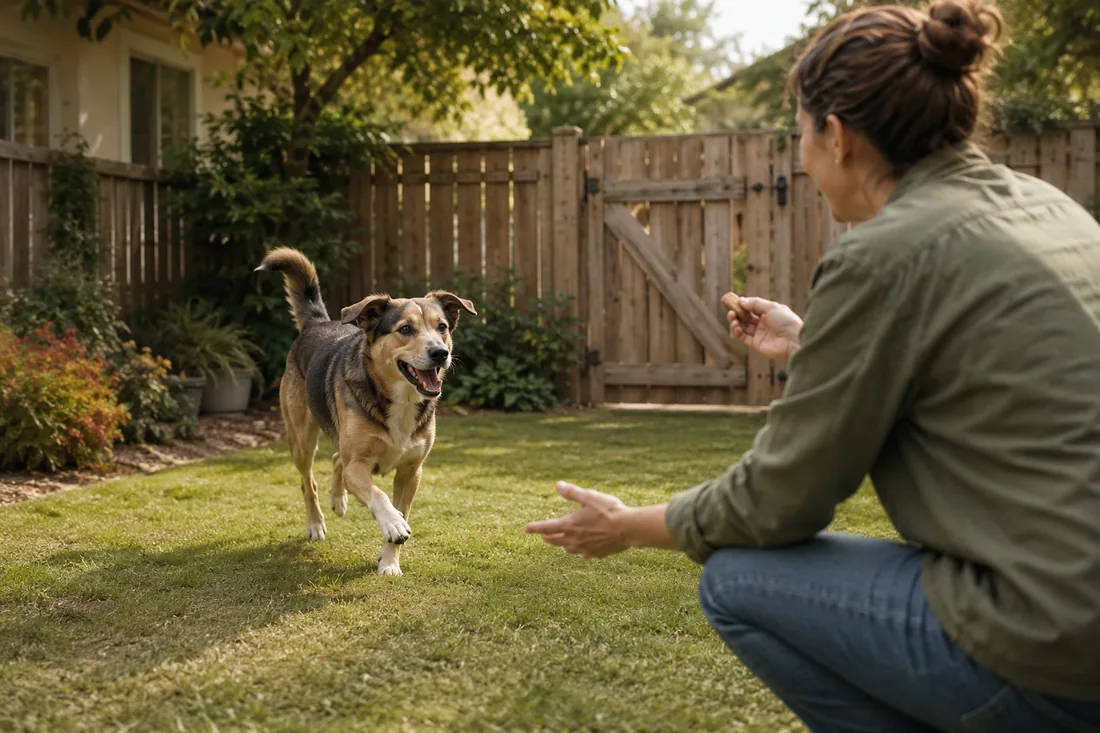
Dog sniffs in a fenced garden.
Owner calls once.
Dog comes.
Owner rewards.
Owner releases the dog to sniff again.
This teaches:
- “Coming back does not always end the fun.”
Only use this in safe, controlled areas.
Long-line safety
In suitable safe areas, a long line can help with recall practice while the dog is still learning.
This page does not recommend any brand or product.
If a long line is used, use it cautiously:
- only in safe areas away from roads and hazards
- only where the owner can handle it safely
- avoid wrapping it around hands or legs
- avoid crowded areas
- avoid places with dogs, children, cyclists, livestock, wildlife, or traffic nearby
- keep practice calm
- do not use the line to yank or reel the dog in.
If the dog hits the end of the line hard, the setup may be too difficult or unsafe.
First-week recall starter plan
Day 1: Name response
Say the dog’s name once.
Reward when the dog looks at you.
Day 2: One-step recall
Take one step away.
Call once.
Reward when the dog comes.
Day 3: Room-to-room recall
Call from a nearby room.
Reward warmly.
Keep it easy.
Day 4: Add release
Call the dog, reward, then release them back to a safe activity.
Day 5: Garden recall
Practice in a secure garden or enclosed private space.
Use easy distances.
Day 6: Add mild distraction
Call when the dog is lightly interested in something, not fully absorbed.
Reward well.
Day 7: Review and reset
Ask:
- Did the dog come happily?
- Did I call only once?
- Was the reward good enough?
- Was the place safe?
- Was the difficulty too high?
Adjust the plan.
Recall games
The two-person game
In a quiet room or safe garden, two people take turns calling the dog.
Each person rewards the dog when they arrive.
Keep the distance short at first.
Do not use this if the dog is worried by either person.
Hide and call indoors
Hide behind a door or furniture in the home.
Call once.
Reward the dog when they find you.
Keep it fun and easy.
Chase me safely
Call the dog, then move a few steps away from them.
Many dogs enjoy following movement.
Reward when the dog catches up.
Do this only in safe areas with good footing.
Troubleshooting
- “My dog ignores the cue.”
The cue may be too weak, the distraction too strong, or the reward not meaningful enough.
Try:
- practicing indoors again
- using a cheerful tone
- reducing distance
- using better rewards
- calling when the dog is likely to succeed
- avoiding repeated cue use when the dog is not ready.
- “My dog comes, grabs the treat, and runs away.”
That can still be progress.
Practice:
- rewarding near you
- gently offering another reward
- releasing the dog back to sniff
- making coming to you feel safe and enjoyable.
Do not grab the dog suddenly unless safety requires it.
- “My dog only comes inside.”
Outside is much harder.
Move gradually:
- indoors
- doorway
- garden
- quiet enclosed area
- long line in a safe place.
Do not rush to open areas.
- “My dog chases wildlife or livestock.”
This article is not enough.
Do not practice around wildlife or livestock. Seek qualified help and follow local laws and safety requirements.
- “My dog runs toward roads.”
Do not practice near roads.
Use secure indoor and enclosed areas only. Seek qualified help if the dog cannot be safely managed.
What not to do
Do not:
- promise off-leash reliability
- practice near roads
- practice near livestock
- practice near wildlife
- practice near open water, cliffs, or hazards
- use this article to practise in open parks, unfenced areas, or any place where the dog could run into danger
- call the dog repeatedly when they are ignoring you
- punish the dog when they come back
- use shock collars, prong collars, choke chains, or leash corrections
- yank the dog with a long line
- let the dog off lead in unsafe areas.
Never punish a dog for coming back, even if they took longer than expected. Coming back should always be safe for the dog.
How this connects to other pages
Recall practice uses the same humane principles as the rest of the site: start easy, reward success, and lower difficulty when needed. Read Humane dog-training principles for the full framework.
For walking practice, read Loose-leash walking without leash corrections.
For short daily structure, read A simple daily training routine for busy dog owners.
If the dog panics, threatens, chases dangerously, or cannot be safely managed, read Dog behavior red flags and when to get professional help.
Common questions
How do I teach my dog to come when called?
Use the SAFE framework: Start indoors, Add distance slowly, Follow with a reward, End with more freedom when safe. Begin in a quiet room — say the dog’s name cheerfully, reward the look, then step away, call once, and reward the return. Build up gradually to the garden, and always make coming back worth it with food, praise, or play.
Why does my dog ignore me when I call him?
Usually the distraction is too strong, the reward is not meaningful enough, or the cue is still weak. Move practice back indoors, shorten the distance, use better rewards, and avoid repeating the cue. If your dog suddenly stops responding after a health or behavior change, or chases traffic or livestock, contact your vet or a qualified behavior professional — see dog behavior red flags.
Should I punish my dog for not coming when called?
No — never punish a dog for coming back, even slowly. Punishment teaches the dog that returning to you is risky, which makes recall worse, not better. The same goes for shock, prong, or choke collars and leash corrections: they add fear without teaching the skill. Reward every return generously, and sometimes release the dog back to safe sniffing so recall does not always end the fun.
When can I let my dog off the leash?
Cautiously, and only where it is genuinely safe. No guide can promise off-leash reliability around traffic, livestock, wildlife, other dogs, or exciting smells. Practice first indoors, then in a secure garden, then on a long line in a safe enclosed area — held safely, never used to yank the dog. Keep the lead on near roads, open parks, and anywhere the dog could run into danger.
Educational disclaimer
This page provides general educational information about simple recall practice in safe settings. It is not veterinary advice, a diagnosis, a safety guarantee, or an individualized training plan.
If the dog shows sudden behavior changes, signs of pain, signs of illness, injury, severe fear, panic, aggression, bites, threats, dangerous chasing, repeated accidents, separation-related distress, or behavior the owner cannot safely manage, contact an appropriate professional.
Sources and further reading
These sources support the humane-training and safety boundaries used on this page. This page is educational only and is not a substitute for veterinary or qualified behavior support.