
A Simple Daily Training Routine for Busy Dog Owners
Dog training does not have to take over the whole day.
For many ordinary training goals, a few short, consistent moments are more realistic than one long session.
This page gives busy dog owners a simple daily structure for everyday, non-dangerous training.
It is not a substitute for veterinary care, qualified behavior support, or an individualized plan when health, pain, sudden behavior change, severe fear, panic, separation-related distress, aggression, bite risk, or dangerous behavior is present.
For the site’s overall boundaries, read What this dog-training site covers. For the training philosophy, read Humane dog-training principles. For safety red flags, read Dog behavior red flags and when to get professional help.
Safety note
This article is for everyday, non-dangerous training only. It should not delay veterinary care or qualified behavior support when health, pain, injury, sudden change, bite risk, severe fear, panic, separation-related distress, or dangerous behavior is present.
This page is educational only. It is not veterinary advice, a diagnosis, or an individualized training plan.
If the dog is suddenly acting differently, seems painful or ill, cannot settle, panics, threatens, bites, or shows behavior the owner cannot safely manage, do not rely on a daily routine article.
The goal: small, repeatable habits
A good daily routine should be:
- short
- kind
- realistic
- flexible
- easy to repeat
- based on rewards
- matched to the dog’s needs
- safe for the owner and dog.
The goal is not to train all day.
The goal is to make good behavior easier during normal life.
The 3-2-1 daily routine
Use the 3-2-1 routine:
- 3 calm reward moments
- 2 tiny training sessions
- 1 simple review
This routine can fit into a normal day without needing complicated tools or heavy daily work.
3 calm reward moments
A calm reward moment means the owner notices something the dog is already doing well and rewards it.
Examples:
- dog lies down quietly
- dog looks at the owner instead of barking in an ordinary, non-dangerous situation
- dog keeps four paws on the floor
- dog walks one step with a loose leash
- dog comes when called indoors
- dog settles while the owner makes coffee
- dog waits calmly while the lead is picked up.
The owner can reward with:
- calm praise
- a small food reward
- a short game
- access to the garden
- a sniff break
- gentle attention if the dog enjoys it.
These moments teach the dog:
- “Good choices are noticed.”
2 tiny training sessions
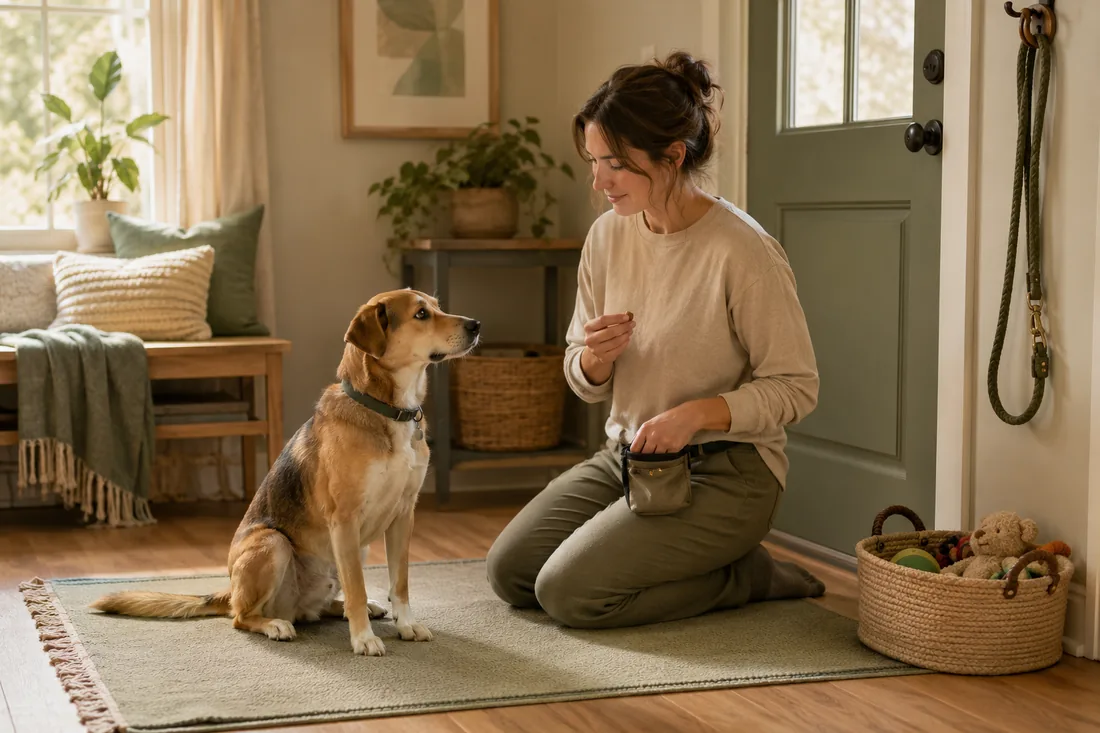
A tiny training session can be one to three minutes.
Choose one skill at a time.
Examples:
- settle on a mat
- four paws on the floor
- loose-leash steps in the hallway
- recall from one room away
- looking at the owner when called
- calm crate approach with the door open
- going to a mat when the owner points.
Keep the session easy.
Stop before the dog gets bored or frustrated.
A tiny session should feel like:
- “That was easy.”
- “That was fun.”
- “We can do that again tomorrow.”
Not:
- “Why is this not working?”
- “Why won’t the dog listen?”
- “We have to keep going until it is perfect.”
1 simple review
At the end of the day, ask three questions:
- What went well?
- What was too hard?
- What should be easier tomorrow?
This review can take less than one minute.
Example:
Went well: dog settled during lunch.
Too hard: ordinary barking at a mild delivery noise.
Easier tomorrow: close the front-room door before delivery time and reward calm away from the door.
The review helps the owner adjust without blaming the dog.
Morning routine example
Morning can be busy, so keep it simple.
Possible routine:
Toilet break or walk.
Reward one loose-leash moment.
Reward calm behavior before breakfast.
Do one minute of recall or settle practice.
Let the dog rest.
Do not turn the morning into a long obedience session.
Midday routine example
Midday can be a reset.
Possible routine:
Short sniffing or play break.
Reward calm behavior afterward.
Practice one easy cue for one minute.
Give the dog a quiet rest period.
If the owner is busy, even one calm reward moment is useful.
Evening routine example
Evening is often when dogs become restless.
Possible routine:
Meet basic needs: toilet, water, appropriate activity, and rest.
Practice settle for one to three minutes.
Reward four paws on the floor during family movement.
Keep greetings and play calm if the dog is overexcited.
End with a predictable bedtime routine.
If the dog suddenly becomes restless at night, cannot settle, seems painful, or has toilet changes, use the red-flag page.
Weekly rotation: one focus per day
To avoid doing too much, choose one focus each day.
Example:
Monday: settle practice.
Tuesday: loose-leash steps.
Wednesday: recall indoors.
Thursday: four paws on the floor.
Friday: calm crate approach.
Saturday: ordinary barking prevention setup.
Sunday: review and easy wins.
This is not a strict plan. It is a menu.
The owner can repeat the same focus for several days if that works better.
How to choose today’s training focus
Use this decision tree.
Step 1: Is there a red flag?
If yes, do not use a routine article as the solution. Read Dog behavior red flags and when to get professional help.
Step 2: What is the easiest useful skill?
Choose something the dog can succeed at today.
Examples:
- one second of settle
- one loose-leash step
- one recall indoors
- one calm pause before greeting
- one look back after a mild, ordinary sound.
Step 3: What routine already happens today?
Attach training to a normal moment:
- before meals
- before walks
- after toilet breaks
- when the kettle boils
- before bedtime
- when the owner sits at a desk.
Step 4: What reward matters today?
Pick something the dog actually wants.
Food, praise, play, sniffing, access, or calm attention may all work depending on the dog and moment.
Step 5: How will the owner make it easier tomorrow?
If today was hard, lower the difficulty.
Troubleshooting
- “I do not have time.”
Use smaller pieces.
One minute can be enough for a useful ordinary training repetition.
Try:
- one recall before breakfast
- one calm reward during coffee
- one loose-leash step before the walk
- one settle reward in the evening.
Consistency matters more than long sessions.
- “My dog gets too excited.”
Use calmer rewards, shorter sessions, and easier setups.
Try How to teach your dog to settle calmly.
If excitement is sudden, extreme, unsafe, or paired with distress, use the red-flag page.
- “My dog pulls every walk.”
Do not try to fix the whole walk at once.
Practice one easy section using Loose-leash walking without leash corrections.
- “My dog jumps on everyone.”
Practice the four-paws routine from How to stop a dog jumping up without punishment.
If children or visitors may be unsafe, use management and get help.
- “My dog barks at noises.”
Check the red flags first.
If no red flags apply, use the barking guide for ordinary, non-dangerous barking.
- “My dog does not come when called.”
Start indoors with Simple recall practice at home and in safe enclosed areas.
Do not practice near roads, wildlife, livestock, open parks, or unsafe areas.
What not to do
Do not:
- train for long periods when the dog is tired or stressed
- keep repeating a cue when the dog is not responding
- punish mistakes
- use shock, prong, choke, leash corrections, dominance, or intimidation
- expect one routine to fix serious behavior problems
- ignore sudden changes or health signs
- use the routine as a substitute for veterinary care or qualified behavior help.
Low-maintenance owner checklist
A simple daily training day can look like this:
One calm behavior noticed and rewarded.
One tiny training session completed.
One normal routine made easier for the dog.
One red-flag check done if behavior seemed unusual.
One note made about what to make easier tomorrow.
This can be enough structure for many ordinary training days.
How this connects to other pages
Use the daily routine to practice small pieces from:
- How to teach your dog to settle calmly
- Positive crate training: humane first steps
- Barking at noises, visitors, and everyday triggers
- How to stop a dog jumping up without punishment
- Loose-leash walking without leash corrections
- Simple recall practice at home and in safe enclosed areas
- Puppy first cues: name, sit, and down
- How to house-train a puppy without punishment
Use What this dog-training site covers and Dog behavior red flags and when to get professional help whenever the issue may be outside ordinary training.
Educational disclaimer
This page provides general educational information about everyday dog-training routines. It is not veterinary advice, a diagnosis, or an individualized behavior plan.
If the dog shows sudden behavior changes, signs of pain, signs of illness, appetite or toilet changes, injury, repeated accidents, severe fear, panic, separation-related distress, aggression, bites, threats to people or animals, or dangerous behavior, contact an appropriate professional.
Sources and further reading
These sources support the humane-training and safety boundaries used on this page. This page is educational only and is not a substitute for veterinary or qualified behavior support.
- RSPCA — How to train your dog
- Dogs Trust — Positive reinforcement: training with rewards
- MSD Veterinary Manual — Behavior problems of dogs
- Cornell Riney Canine Health Center — Recognizing pain in dogs
- ASPCA — Behavioral help for your pet
- Dogs Trust — How to train your dog to be calm, relax and settle
- Dogs Trust — Dog training basics
- Dogs Trust — Dog training advice
- CDC — Dogs: Healthy Pets, Healthy People
- Dogs Trust — How to stop your dog barking
- RSPCA Knowledgebase — Teach dog recall
- AVSAB — Humane Dog Training Position Statement
- BC SPCA — Position statement on animal training
- MSD Veterinary Manual — Treatment of behavior problems in animals