Teaching a Puppy First Cues: Name, Sit, and Down
The first words you teach a puppy are not really about obedience. They are about building a shared language — a few simple signals that mean “good things are about to happen if you do this.” Done kindly, those early lessons teach your puppy that paying attention to you is rewarding, that learning is fun, and that you are safe and worth listening to.
Three cues make an excellent starting point: responding to their name, sit, and down. They are easy to lure with food, easy to reward, and useful every single day. None of them require force, scolding, or pushing the puppy around. For the methods behind this approach, read humane dog-training principles, and for what this site does and does not cover, read what this dog-training site covers.
Safety note
This article is educational only. It is not veterinary advice, a diagnosis, or an individualized training plan.
A puppy who cannot or will not learn simple things may sometimes be uncomfortable, unwell, or struggling to see, hear, or move easily. Contact a veterinarian if a puppy seems unusually tired, sore, reluctant to move, sensitive when touched, or otherwise unwell, and never use training to push through a dog who seems to be in pain. If a once-responsive dog suddenly stops paying attention or changes in behavior, read sudden dog behavior change, and if the dog may be uncomfortable, read signs of pain in dogs.
When this guide is a good fit
This guide may help if:
- you have a healthy puppy or newly adopted dog ready to learn their first words
- you want a calm, reward-based method with no force or punishment
- you would like short, simple sessions you can fit into ordinary days
- you want foundations that make later training easier.
This guide is not enough if:
- a puppy seems unwell, painful, or strangely unwilling to move or focus
- there is fear, panic, growling, snapping, or guarding around food or hands
- a previously responsive dog suddenly will not engage at all
- you need help with a serious or worrying behavior problem.
In those situations, speak to a veterinarian or a qualified positive-reinforcement behavior professional. If you are ever unsure whether something needs professional help, check the dog behavior red flags.
The basics that make every cue work
Before any specific word, three habits make training quicker, clearer, and kinder. Get these right and the cues almost teach themselves.
Mark the exact right moment
Puppies learn best when they know precisely which action earned the reward. A short marker — a clicker, or a quick word like “yes” said the same way every time — acts like a camera shutter that snaps the good moment. The instant the puppy does the thing you want, you mark, and then you deliver a small treat. The marker says “that, right there, is what paid off.” Without it, the reward can feel random and learning is slower.
Reward promptly and generously
Use small, soft, tasty treats the puppy can eat in a second so you can keep going. Deliver the reward within about a second of the marker. For early lessons, reward every correct response — you are building enthusiasm, not testing willpower. You can use part of the puppy’s daily food for training so the extra calories stay sensible.
Keep sessions short and end on success
A baby puppy’s focus is measured in seconds, not minutes. Two or three sessions of one to three minutes each, scattered through the day, beat one long session that ends in frustration. Always stop while the puppy is still keen, ideally just after an easy win, so they finish wanting more. If your puppy wanders off, gets the zoomies, or stops taking treats, the session is over — that is normal, not disobedience.
Cue 1: Responding to their name
The first and most useful thing a puppy can learn is that their name means “look at me, something good is coming.” A name should never be a telling-off. If you only say it when you are cross, the puppy learns to tune it out.
- In a quiet room with no distractions, wait until the puppy is not already staring at you.
- Say their name once, in a bright, friendly voice.
- The moment they turn or glance toward you, mark (“yes”) and give a treat.
- Repeat a handful of times, then take a break.
If the puppy does not respond at first, you can make a small noise — a kissy sound or a soft clap — to get the glance, then reward. Soon the name alone will earn that turn of the head. Practise this little game often, in lots of calm moments, so the name becomes a reliable “check in with me” signal you can rely on later.
Cue 2: Sit
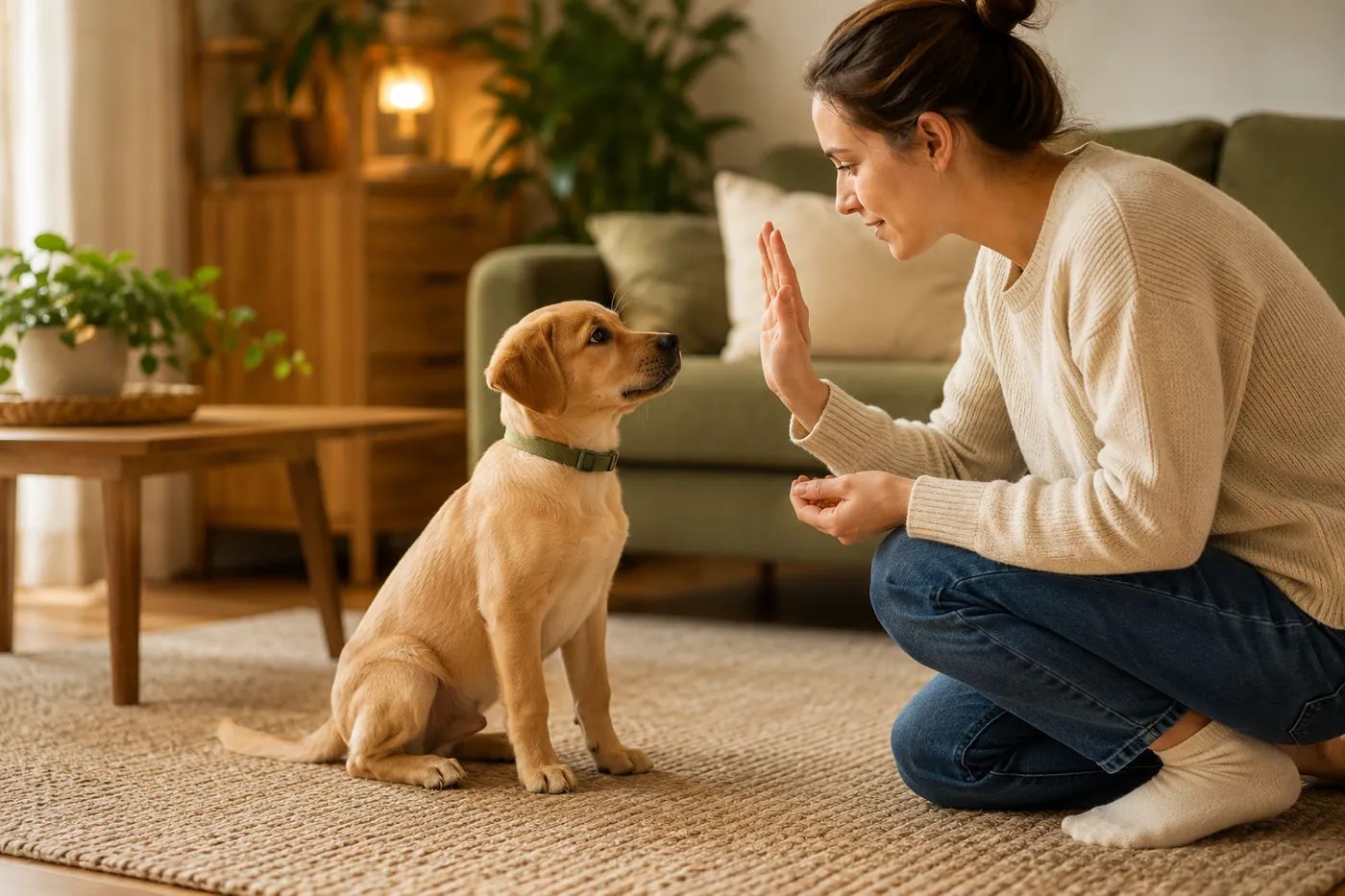
Sit is the classic first cue because it is easy to lure and naturally calming. A puppy who can sit has a polite default to offer instead of jumping or pawing.
Lure the sit
- Hold a small treat right at the puppy’s nose so they can smell it.
- Slowly move the treat up and slightly back over their head, toward their tail.
- As their nose follows the treat up, their bottom naturally lowers to the floor.
- The instant they sit, mark (“yes”) and give the treat.
Move slowly. If the puppy jumps up or backs away, your hand is probably too high — keep it close to the nose. Do this a few times until the sit comes easily from the lure.
Fade the lure, then add the word
Once the puppy is following the treat into a sit smoothly, start to fade the food from your hand. Make the same upward hand motion with no treat hidden in it, then mark and reward from your other hand or a pocket once they sit. Over a few sessions the hand movement can shrink into a small, natural gesture.
Only add the word once the action is reliable. Say “sit” just before you make the hand motion, so the word predicts the movement. With repetition, the puppy learns that “sit” itself means lower your bottom, and you can drop the gesture. Saying the word over and over while the puppy ignores it only teaches them the word is meaningless.
Cue 3: Down
Down (lying flat) is a comfortable, settled position that pairs well with calm. Many puppies find it easiest to learn from a sit, though some prefer being lured straight to the floor.
Lure the down
- Start with the puppy in a sit if they know it, or simply standing.
- Hold a treat at their nose, then move it slowly straight down to the floor between their front paws.
- Keep the treat on the floor and, if needed, slide it slowly away from them like the bottom of an “L.”
- As they follow it down, their elbows lower until they are lying flat. The moment they do, mark (“yes”) and give the treat.
If the puppy’s bottom pops up instead of the elbows going down, slide the treat a little closer to their chest. If they lose interest, make the treat more tempting or take a break. Reward any progress at first — even an elbow dipping toward the floor — and build up to the full down over several tries.
Fade the lure, then add the word
As with sit, once the puppy flows into the down by following your hand, start making the same motion without food in your hand and reward afterward. Then add the word “down” just before the hand signal, and gradually let the word do the work on its own. Keep it calm and unhurried; down is a relaxed position, so a relaxed pace suits it.
Reasonable expectations and adding difficulty
A young puppy is a baby. Expect a short attention span, lots of distraction, and plenty of off days. Progress is rarely a straight line, and that is fine.
Always start where it is easy — a quiet room, no other people or dogs, no exciting smells. Once a cue is solid there, raise the difficulty one small step at a time:
- practise in a different room, then the garden, then a calm spot outdoors
- add gentle distractions, such as a toy nearby or a person sitting quietly
- ask from a little further away, or while you are standing rather than crouching
- only stretch one thing at a time, and drop back a step if responses fall apart.
This is sometimes called “proofing” — helping the puppy understand that “sit” means sit everywhere, not only in the kitchen at treat time. Go at your puppy’s pace, not a timetable.
Troubleshooting
“My puppy jumps up instead of sitting.”
Your luring hand is probably too high. Keep the treat right against the nose and move it slowly back over the head rather than upward. If the puppy is bouncy, try when they are a little calmer, and reward the moment their bottom touches the floor.
“My puppy ignores their name.”
Names get ignored when they have been used for telling off, or said so often they lose meaning. Go back to the quiet name game, reward every glance generously, and never use the name to scold. Say it once, then make it worth their while to look.
“My puppy will not lie down.”
Down can be harder than sit. Lure slowly, slide the treat along the floor away from the chest, and reward any movement toward the ground at first. Trying on a soft, comfortable surface helps, as some puppies dislike lying on cold or slippery floors.
“My puppy only responds when I am holding food.”
This means the lure has not been faded yet. Start making the same hand motion with no treat in that hand, then reward from a pocket or your other hand once they respond. Bring rewards back in unpredictably over time so the cue stays strong without a visible treat.
“My puppy loses interest after a few seconds.”
That is completely normal for a young puppy. Keep sessions to a minute or two, use tastier treats, train before mealtimes when they are a little hungry, and always stop while they still want more.
What not to do
Do not:
- push the puppy’s bottom down into a sit or press on their back or hips
- force a puppy into a down by pulling their legs or pressing their shoulders
- use leash pops, jerks, or corrections to make them comply
- shout, scold, or repeat a word angrily when the puppy does not respond
- use the puppy’s name as a punishment
- use shock, prong, or choke collars, or any device meant to startle or hurt
- lean on dominance or “alpha” explanations — they are outdated and unhelpful.
Forcing a puppy’s body into position teaches them to brace against your hands rather than to think and offer the behaviour themselves. Luring lets the puppy choose to move, which learns faster and protects your relationship.
How this connects to other pages
First cues fit naturally into the rest of a calm puppy life. Fold them into a simple daily training routine so practice becomes a happy habit, and pair sit and down with teaching a puppy to settle calmly. Once these basics are solid, you can move on to skills like “leave it” and “drop it” and a friendly recall. For the overall approach, see humane dog-training principles, and if you are ever unsure whether a problem needs professional help, check the dog behavior red flags.
Educational disclaimer
This page provides general educational information about teaching ordinary first cues to healthy puppies and dogs using reward-based methods. It is not veterinary advice, a diagnosis, or an individualized behavior plan.
If the dog shows signs of pain or illness, sudden loss of responsiveness, severe fear, panic, growling, snapping, or guarding, contact an appropriate professional such as a veterinarian or qualified positive-reinforcement behavior professional.
Sources and further reading
These sources support the humane-training and welfare boundaries used on this page. This page is educational only and is not a substitute for veterinary or qualified behavior support.
- Dogs Trust — Dog training basics
- Dogs Trust — Positive reinforcement: training with rewards
- RSPCA — How to train your dog
- ASPCA — Behavioral help for your pet
- AVSAB — Humane Dog Training Position Statement
- BC SPCA — Position statement on animal training
- MSD Veterinary Manual — Treatment of behavior problems in animals