How to Teach a Puppy “Leave It” and “Drop It”
“Leave it” and “drop it” are two of the most useful safety cues a puppy can learn. They are the everyday tools that help you steer a curious mouth away from a dropped pill, a chicken bone on the pavement, or a sock that should not be swallowed. Taught kindly, they also make life calmer for everyone, because you are not constantly chasing your puppy around the house.
The key idea on this page is simple: you are not taking things away from your puppy, you are teaching them that giving something up — or not grabbing it at all — pays off. We do this with rewards and trades, never by prying a mouth open, snatching, or chasing. For the methods behind it, read humane dog-training principles, and for what this site does and does not cover, read what this dog-training site covers.
This guide is for ordinary, healthy puppies and friendly young dogs who pick things up out of curiosity and play. It is not for dogs who already guard food or objects — that situation needs a different, careful approach, covered in the safety note below.
Safety note
This article is educational only. It is not veterinary advice, a diagnosis, or an individualized training plan.
Do not try to teach these cues by confronting a puppy who already guards. If your puppy stiffens, freezes, eats faster when you approach, hovers over an item, lifts a lip, growls, snaps, or runs off and gulps things down when you come near, stop and do not push it. Trying to take items by force from a guarding dog can make the behavior worse and can lead to a bite. This is a sign to get qualified help rather than to win a struggle. See dog behavior red flags for when to involve a professional, and read the ASPCA guidance on food guarding linked in the sources. If a guarding tendency has appeared suddenly in a dog who was fine before, also read sudden dog behavior change and signs of pain in dogs, because discomfort can change behavior.
If your puppy has actually swallowed something dangerous — a bone, a battery, medication, a sharp object, a toxic plant, or a quantity of a foreign material — contact a veterinarian straight away. Training never replaces an urgent vet call.
When this guide is a good fit
This guide may help if:
- you have a healthy, friendly puppy who picks things up out of curiosity
- your puppy grabs socks, tissues, food off the floor, or items on walks
- you want safety cues taught calmly, as a happy game, with no force
- your puppy will happily swap one item for a treat without tension.
This guide is not enough if:
- your puppy stiffens, freezes, growls, snaps, or guards food or objects
- your puppy panics or runs off and gulps items when you approach
- a calm dog has suddenly started guarding or grabbing in a new way
- your puppy has swallowed something and may need urgent veterinary care.
In those situations, speak to a veterinarian or a qualified positive-reinforcement behavior professional rather than working through it alone. Guarding, in particular, is a job for proper hands-on help — see when to get professional help.
Why “leave it” and “drop it” are different
People often blur these two cues, but they do different jobs, and it helps to keep them separate in your own mind.
- “Leave it” means do not pick that up — the item is still on the floor or out of the mouth. It is your “before” cue, for spotting something tempting and steering past it.
- “Drop it” means let go of what is already in your mouth. It is your “after” cue, for when the puppy has grabbed something and you need it back.
Both are taught the same way underneath: the puppy learns that cooperating with you reliably leads to something good. Neither cue should ever involve grabbing, chasing, or forcing the mouth open.
The trade-up mindset
The single most important idea here is trading up. Instead of taking an item away, you offer the puppy something they value more — a tasty treat, a favourite toy, or a fun game — in exchange. Over many calm repetitions, the puppy learns that your hand reaching toward them means a good swap is coming, not a loss.
Why this matters so much: if you routinely chase a puppy or wrestle items out of their mouth, you teach them the opposite lesson. They learn that humans steal valuable things, so the smart move is to grab, run, and swallow quickly before you reach them. That is exactly how resource guarding starts. A puppy who trusts that giving up an item leads to a reward has no reason to guard. Kindness here is not only nicer — it is genuinely safer.
Teaching “drop it” with trades
It is often easiest to start with “drop it,” because puppies pick things up constantly and you will have plenty of natural practice. Work in a calm, low-distraction space at first.
Step 1: start with two toys
Give your puppy a toy they like and let them hold it. Have a second toy of equal or higher value in your other hand. Make the second toy interesting — wiggle it along the floor — so the puppy wants it. Most puppies will drop the first toy to investigate the second.
Step 2: reward the moment they let go
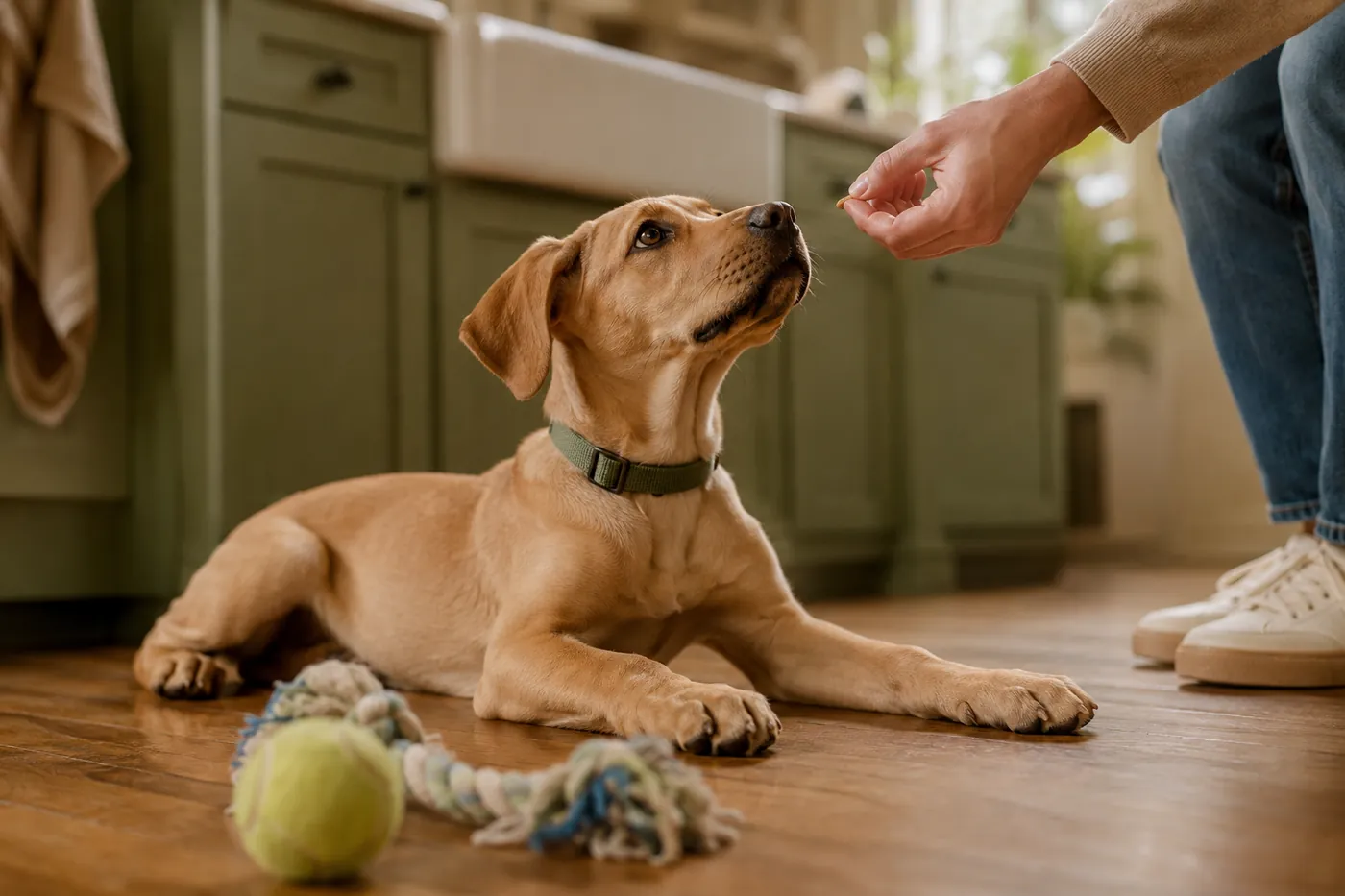
The instant the first toy leaves their mouth, mark it with a calm “yes” or “good,” then let them have the second toy or a small treat. Pick up the first toy without fuss. You are showing the puppy that letting go makes a new good thing appear.
Step 3: add the word once it is reliable
After many successful swaps, your puppy will start to drop the first toy as soon as you offer the swap. Now — and only now — say “drop it” in a light, friendly voice just before they let go. Repeat until the words alone predict the release. Adding the cue too early simply attaches the word to nothing.
Step 4: practise with treats instead of a second toy
Once the pattern is solid, you can sometimes say “drop it,” scatter a few treats on the floor, and let the puppy release the item to eat them. Vary your rewards so the cue stays a happy surprise rather than a routine you must always pay for in advance.
Teaching “leave it” step by step
“Leave it” teaches your puppy to turn away from something tempting instead of grabbing it. Build it up gently so the puppy almost always succeeds.
Step 1: a treat in a closed hand
Put a low-value treat in your closed fist and let your puppy sniff, lick, and nudge it. Do nothing and say nothing. The moment they stop trying and pull their nose away, mark with “yes” and reward — but reward from your other hand, not the fist they were working at. This teaches that backing off, not pushing in, earns the treat.
Step 2: the treat on an open palm
Once they reliably give up on the closed fist, hold a treat on a flat open palm. If they go for it, simply close your hand. When they hold back even briefly, mark and reward from the other hand. You are raising the difficulty a little at a time.
Step 3: the treat on the floor, covered
Place a treat on the floor and cover it with your hand or foot. Let the puppy try, then reward the moment they back off. Gradually expose more of the treat over several sessions, always ready to cover it again if they lunge.
Step 4: add the word
When your puppy is consistently choosing to look away from the food, start saying “leave it” calmly just as you present it. With practice, the words alone will prompt them to turn away. Always reward from your hand, so the puppy learns they never lose by leaving something — they gain.
Step 5: build toward real objects
Practise with a dropped toy, then a more exciting item, then food on a low surface. Keep each step easy enough that the puppy succeeds most of the time. If they grab the item, you have moved too fast — go back a step rather than telling them off.
A simple first-two-weeks plan
Days 1–4: short, easy wins
Run two or three tiny sessions a day, just a minute or two each. Focus on the toy-swap version of “drop it” and the closed-fist version of “leave it.” Reward generously and stop while the puppy is still keen.
Days 5–9: add the words
Once the behaviours happen smoothly, begin attaching the cues “drop it” and “leave it.” Keep sessions short and the mood light. Mix in real moments, such as swapping for a sock the puppy has picked up around the house.
Days 10–14: gentle real life
Start using the cues during normal routines — a treat dropped in the kitchen, a leaf on a calm walk. Keep distractions low and rewards ready. If something goes wrong, make a note to practise that situation more, then move on.
Generalizing to real life
Puppies do not automatically know that a cue learned in the living room also applies in the park. Help them connect the dots by practising the same simple steps in new places, one small change at a time — a different room, then the garden, then a quiet path. Lower your expectations whenever the setting gets harder, and raise the value of your rewards to match the temptation.
On walks especially, keep your puppy on a lead while these cues are still new, so a tempting find never becomes a chase. If you are also working on walking calmly, see loose-leash walking without corrections, and pair “leave it” with a happy recall so your puppy turns back to you instead of toward the temptation.
Keep it a happy game
These cues work best when they feel like a fun, rewarding game rather than a tug-of-war of wills. Keep your voice light, stop before your puppy gets bored, and end on a success. Never use the cues only to take fun things away — sometimes ask for a “drop it,” reward it, and then hand the toy straight back, so cooperating does not always mean the game is over.
Troubleshooting
“My puppy grabs the item and runs away.”
This usually means past attempts to take things by force taught the puppy to flee. Stop chasing — chasing is a thrilling game and confirms their fear of losing the item. Instead, go quiet, fetch a high-value treat or toy, and calmly offer a trade. Rebuild trust with lots of easy swaps where the puppy always comes out ahead.
“My puppy ignores ‘leave it’ when the item is really exciting.”
The temptation has outpaced your reward. Drop back to an easier version, increase the value of your treat, and add distance between the puppy and the item. Build difficulty more slowly so the puppy keeps succeeding.
“My puppy drops the toy but snatches it back.”
Mark and reward the instant the item leaves the mouth, and quietly remove or cover the item a beat sooner. A faster reward and smoother hands usually fix this. Keep sessions calm so the puppy is not over-aroused.
“My puppy gets tense or growls when I come near a chew.”
Do not push this. Tension or growling around food or chews is guarding, not a training gap, and confronting it can make it worse. Give the puppy space, avoid taking the item, and arrange help from a veterinarian or qualified positive-reinforcement behavior professional. Start with the dog behavior red flags and the ASPCA food-guarding guidance in the sources.
“My puppy already swallowed something.”
If it could be harmful — a bone, a battery, medication, a sharp object, a toxic plant, or a large amount of any material — contact a veterinarian straight away rather than waiting to see what happens.
What not to do
Do not:
- chase your puppy to get an item back
- pry the mouth open or force items out
- snatch things away or punish the puppy for grabbing
- shout, smack, or hold the muzzle shut
- use shock, prong, or choke collars or leash corrections
- rely on dominance or “alpha” explanations
- confront a puppy who stiffens, freezes, or guards.
All of these teach a puppy that humans are a threat to valuable things, which makes grabbing, hiding, and guarding more likely — the exact opposite of what you want from these safety cues.
How this connects to other pages
“Leave it” and “drop it” fit naturally with the rest of a calm puppy routine. They pair well with a puppy’s first cues — name, sit, and down, and they slot easily into a simple daily training routine. Teaching a puppy to settle calmly reduces the over-excitement that drives grabbing, and gentle work on biting and nipping uses the same kind, reward-based mindset. For the overall approach, see humane dog-training principles, and if you are ever unsure whether a problem needs professional help, check the dog behavior red flags.
Educational disclaimer
This page provides general educational information about teaching ordinary safety cues to healthy, friendly puppies and dogs. It is not veterinary advice, a diagnosis, or an individualized behavior plan.
If the dog stiffens, freezes, growls, snaps, or guards food or objects, panics or flees when approached, has swallowed something potentially harmful, or shows any sudden change in behavior or signs of pain or illness, contact an appropriate professional such as a veterinarian or qualified positive-reinforcement behavior professional.
Sources and further reading
These sources support the humane-training and welfare boundaries used on this page. This page is educational only and is not a substitute for veterinary or qualified behavior support.