
How to Reduce Puppy Biting and Nipping Without Punishment
Sharp little teeth on your hands, ankles, and sleeves are one of the most common — and most surprising — parts of life with a new puppy. If your puppy bites, nips, and mouths constantly, you are not doing anything wrong, and your puppy is not broken.
For almost all young puppies, biting and mouthing are completely normal. Puppies explore the world with their mouths the way human babies explore with their hands. They mouth when they play, when they are teething, when they are excited, and especially when they are overtired. This is not dominance, and it is not aggression — it is a developmental stage that, with kind and consistent handling, fades as the puppy grows.
This guide is for ordinary, healthy puppies learning gentler mouth manners. For the methods behind it, read humane dog-training principles, and for what this site does and does not cover, read what this dog-training site covers.
The quick answer
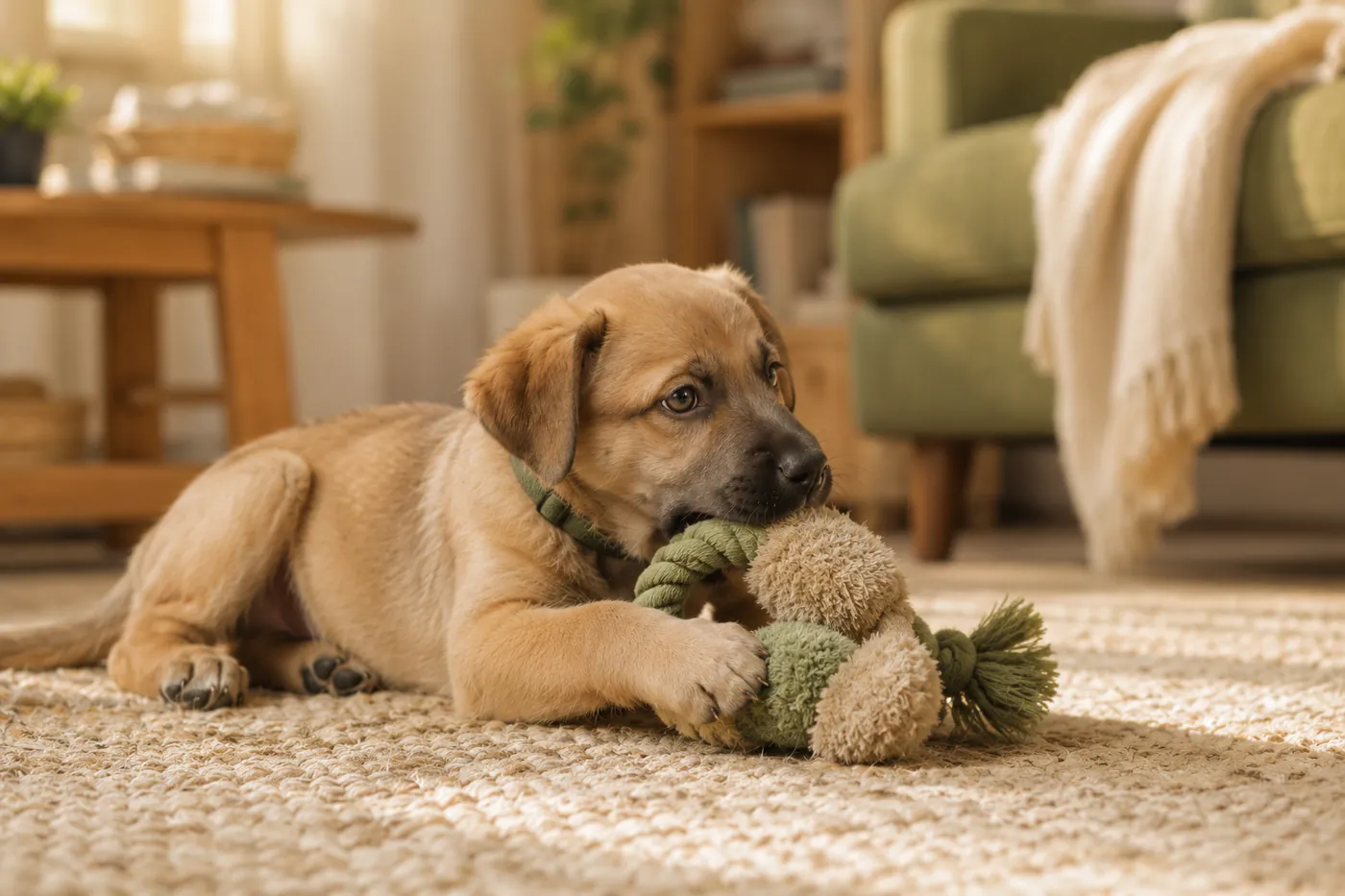
Puppy biting and nipping are a normal developmental stage, not dominance or aggression. Reduce them with the reward-based approach — redirect, reward, rest: move teeth from skin onto an appropriate chew toy, reward gentle mouths and calm play, and protect plenty of sleep, because overtired puppies bite far more. Punishment is never needed and can make biting worse.
- Pause play when teeth touch skin: go quiet, still, and briefly disengage — gentle mouths keep the game going, hard mouths end it for a moment.
- Redirect to a toy, keeping safe puppy chews within easy reach in every room and praising warmly the instant the puppy grabs the toy instead of your hand.
- Reward calm and gentle play, catching the puppy getting it right with quiet praise and an occasional small treat rather than reacting only when teeth appear.
- Protect rest and manage excitement: much frantic “witching hour” biting comes from an overtired puppy, so build in quiet downtime before play turns wild.
Safety note
This article is educational only. It is not veterinary advice, a diagnosis, or an individualized training plan.
Most puppy mouthing is normal play and exploration, but not all biting is. If a puppy or dog bites with stiffness, freezing, hard staring, growling with intent, snapping when approached over food or objects, or in a way that escalates in force, that is different from ordinary play and needs proper assessment. The same is true if biting breaks skin in an older dog, or if anyone in the home feels unsafe. In those cases, read the dog behavior red flags and speak to a qualified positive-reinforcement behavior professional. For general bite-safety guidance, the AVMA dog-bite prevention resource is a useful starting point. If a calm dog suddenly starts mouthing or snapping where it did not before, this can be a sign of pain or illness — read signs of pain in dogs and sudden dog behavior change, and contact a veterinarian.
When this guide is a good fit
This guide may help if:
- you have a healthy young puppy who mouths hands, sleeves, and ankles in play
- the biting is worse during excited play, after meals, or when the puppy is overtired
- your puppy is teething and chewing on everything it can reach
- you want a calm, reward-based plan you can keep up day to day.
This guide is not enough if:
- the biting comes with stiffness, freezing, growling with intent, or hard staring
- your dog snaps or guards when approached over food, toys, or resting spots
- biting in an older dog regularly breaks skin or is escalating in force
- the puppy seems fearful or panicked rather than playful
- anyone in the home, especially a child, is being injured or frightened.
In those situations, speak to a veterinarian or a qualified positive-reinforcement behavior professional. Biting that is driven by fear, pain, or guarding needs proper help, not more play training — see the dog behavior red flags.
Why puppies bite and nip
Understanding the reason behind the biting makes the response much easier. Most puppy mouthing comes from a few overlapping causes:
- Exploration — puppies investigate textures, objects, and people with their mouths.
- Play — littermates wrestle and mouth each other, and puppies try the same with us.
- Teething — sore gums, usually between roughly three and six months of age, make chewing feel good.
- Over-excitement — fast, rough, or hands-on play winds a puppy up until the teeth come out.
- Overtiredness — like a cranky toddler, an under-rested puppy often bites far more, not less.
None of these is the puppy being “dominant,” spiteful, or trying to take charge. Reading the cause helps you choose the kind response: a teething puppy needs something appropriate to chew, while an overtired one usually needs a quiet rest, not more training.
The reward-based approach: redirect, reward, rest
A simple way to remember the whole plan is three words:
- Redirect — move teeth from skin to an appropriate toy or chew.
- Reward — notice and reinforce gentle mouths and calm play.
- Rest — protect sleep and downtime, because tired puppies bite less.
Around these three ideas sits one more skill that helps for life: teaching a soft, gentle mouth, often called bite inhibition.
Teaching bite inhibition (a gentle mouth)
Bite inhibition is a puppy learning to control how hard it uses its mouth. Puppies first learn this from their mother and littermates: when one bites too hard, play stops. You can carry on that lesson kindly.
Let play pause when teeth touch skin
When you are playing and the puppy's teeth make contact with your skin, calmly stop the fun for a moment. You do not need to yelp dramatically, scold, or react with drama — a quiet, neutral pause is enough. The lesson the puppy learns is simple: gentle mouths keep the game going, hard mouths end it briefly.
Disengage rather than punish
The most effective response to teeth on skin is to remove the fun, not to add anything unpleasant. Stand up, fold your arms, look away, or briefly leave the room for a few seconds. Then quietly return and carry on. Over many repetitions, the puppy learns that soft mouths mean attention and play continue, while sharp ones make the person become boring.
Redirect to appropriate toys and chews
Puppies have a strong need to chew, especially while teething, so the goal is to give that drive somewhere acceptable to land rather than trying to switch it off.
- Keep a few safe, puppy-appropriate chew toys within easy reach in each room.
- The instant the puppy starts to mouth your hand, calmly offer a toy instead and let them grab that.
- Praise warmly when they take the toy, so chewing the right thing pays off.
- For teething, some puppies enjoy a chew toy that has been chilled, which can soothe sore gums.
Redirecting works best when it is quick and matter-of-fact. You are not telling the puppy off for wanting to chew — you are showing them what they are allowed to chew. This pairs naturally with teaching a puppy to “leave it” and “drop it”, which gives you a calm way to trade up from skin or forbidden items to a toy.
Reward calm and gentle play
It is easy to react only when the teeth come out, but reward-based training works far better when you also catch the puppy getting it right.
- When the puppy plays with a soft mouth or chews its own toy, calmly praise and, now and then, add a small food reward.
- When the puppy chooses to settle near you instead of mouthing, quietly reward that calm.
- Keep your own movements smooth and unhurried; jerky hands and fast play invite grabbing.
Over time the puppy notices that gentle mouths and calm behaviour are what earn attention, treats, and continued play. Teaching a puppy to settle calmly is one of the most useful things you can do, because a settled puppy is not a biting puppy.
Manage arousal and protect rest
Much puppy biting is really an over-excitement and over-tiredness problem in disguise. A puppy that has been playing hard, or one that has been awake too long, will often bite more wildly, not less.
- Watch the wind-up. If play is getting frantic and bitey, that is the moment to slow down, not push on.
- Build in downtime. Young puppies need a great deal of sleep. Offer quiet rest in a comfortable spot before the puppy melts down.
- Keep play styles calm. Gentle games and short sessions wind a puppy up far less than rough, hands-on wrestling.
A quiet, comfortable space helps a tired puppy switch off. Introduced kindly, a crate or pen can support this — see positive crate training — and for night-time, read helping a puppy settle and sleep at night. Never use the crate or any confinement as a punishment; it is a rest space, not a penalty.
Puppy-proofing, exercise, and enrichment
A puppy with nothing better to do, or with too much pent-up energy, will find your hands and furniture all the more tempting.
- Puppy-proof rooms so tempting but unsafe items are out of reach, and acceptable chews are easy to find.
- Offer age-appropriate physical activity, without overdoing it on a growing body.
- Add gentle mental enrichment — short training games, sniffing, and food puzzles — to tire the mind kindly.
A predictable rhythm of activity, training, and rest helps enormously. A simple daily training routine spreads enrichment through the day so the puppy is calmer overall.
Child safety
Children and puppies can grow into wonderful companions, but puppy biting is exactly the area where extra care matters most.
- Always supervise interactions between puppies and children, closely and actively.
- Do not use children as chew targets or trainers. A puppy biting tiny, fast-moving hands and ankles is overstimulating for the puppy and unfair on the child.
- Teach children to be calm and still when the puppy gets mouthy, and step in to manage the situation yourself.
- Give both space. Use gates or pens so the puppy and child can have separate, safe areas when you cannot supervise.
If a puppy is regularly biting a child, or if a child is frightened or injured, treat that as a reason to get qualified, humane help promptly rather than waiting for the puppy to grow out of it.
Troubleshooting
“My puppy bites worse in the evening, like a switch flips.”
This is the classic overtired puppy. The “witching hour” of frantic biting usually means too little rest, not too little exercise. Build in calm downtime earlier in the day and help the puppy settle before it gets wild.
“Yelping or saying ‘ow’ seems to make my puppy more excited.”
Some puppies find a sharp yelp thrilling and bite harder. If that is your puppy, skip the noise and simply go quiet, still, and briefly disengage instead. Calm and boring is the goal.
“My puppy chases and bites my ankles and trouser legs.”
This is common, motion-driven play. Stop moving so your feet become boring, then redirect to a toy. Carrying a toy you can offer the moment ankle-biting starts helps a great deal.
“We have tried for weeks and there is little change.”
Genuine progress can take time, and teething stages come and go. Stay consistent, make sure everyone in the home responds the same way, and protect rest. If the biting is escalating in force, comes with growling, stiffness, or fear, or anyone is being hurt, stop trying to manage it alone and read the dog behavior red flags for the path to professional help.
“My older dog has started mouthing or snapping and never used to.”
A change like this is not normal puppy mouthing and can signal pain, illness, or distress. Read signs of pain in dogs and sudden dog behavior change, and contact a veterinarian rather than treating it as a training issue.
What not to do
Do not:
- smack, flick, or physically punish a puppy for biting
- hold the puppy's mouth shut, pin it down, or scruff it
- shout, frighten, or “alpha roll” a puppy
- use shock, prong, or other aversive collars or corrections
- encourage rough hands-on wrestling and then punish the biting it causes
- use children as chew targets or leave a child unsupervised with a mouthy puppy
- explain the biting as “dominance” and respond with force.
Punishment-based methods tend to make a puppy more anxious and can teach it to bite without the earlier warning signs, which is more dangerous, not less. Kind, consistent redirection and good rest build a gentle mouth far more reliably.
How this connects to other pages
Calmer mouths come from the whole picture, not biting alone. Teaching a puppy to “leave it” and “drop it” gives you a gentle way to trade up to toys, learning to settle calmly reduces the over-excitement behind much biting, and a simple daily training routine keeps the puppy enriched and rested. Early skills like a puppy's first cues — name, sit, and down build communication, and a comfortable rest space supported by positive crate training helps a tired puppy switch off. For the overall approach, see humane dog-training principles, and if you are ever unsure whether biting needs professional help, check the dog behavior red flags.
Common questions
How do I stop my puppy from biting me?
Calmly stop play the moment teeth touch your skin — go quiet, still, and briefly disengage rather than scolding — then offer an appropriate chew toy and praise the puppy for taking it. Reward gentle mouths and calm play whenever you spot them, and protect plenty of sleep. Over many consistent repetitions, the puppy learns that soft mouths keep attention and play going.
Why does my puppy bite more in the evening?
Frantic evening biting — the so-called witching hour — usually means the puppy is overtired, not under-exercised. Like cranky toddlers, under-rested puppies bite far more. Young puppies need a great deal of sleep, so build in calm downtime earlier in the day and help the puppy settle in a quiet, comfortable spot before it winds up into a meltdown.
Should I yelp when my puppy bites me?
You can try it, but it backfires with many puppies — some find a sharp yelp thrilling and bite harder. A quiet, neutral pause works better: stop the fun, go still, look away, or briefly leave the room, then calmly return. The puppy learns that gentle mouths keep the game going while hard mouths make you boring — no drama or punishment needed.
When is puppy biting a serious problem?
Most puppy mouthing is normal play and exploration, but biting with stiffness, freezing, hard staring, growling with intent, guarding of food or objects, or escalating force is different. The same applies if skin is broken in an older dog or a child is hurt or frightened. Read the dog behavior red flags and speak to a veterinarian or qualified positive-reinforcement behavior professional.
Educational disclaimer
This page provides general educational information about ordinary biting, nipping, and mouthing in healthy puppies. It is not veterinary advice, a diagnosis, or an individualized behavior plan.
If a dog bites with stiffness, freezing, growling with intent, guarding, or escalating force, if biting breaks skin in an older dog, if a calm dog suddenly becomes mouthy, or if anyone in the home is being injured or frightened, contact an appropriate professional such as a veterinarian or qualified positive-reinforcement behavior professional.
Sources and further reading
These sources support the humane-training and welfare boundaries used on this page. This page is educational only and is not a substitute for veterinary or qualified behavior support.
- ASPCA — Common dog behavior issues
- ASPCA — Behavioral help for your pet
- Dogs Trust — Dog training basics
- Dogs Trust — Positive reinforcement: training with rewards
- RSPCA — How to train your dog
- AVMA — Dog bite prevention
- AVSAB — Humane Dog Training Position Statement
- MSD Veterinary Manual — Behavior problems of dogs