DIY snuffle mats and scatter feeding
Dogs experience the world nose-first. Hunting out food with that remarkable nose is one of the most natural behaviours a dog has — and it happens to be one of the cheapest, easiest forms of enrichment you can offer at home. Ten minutes of focused foraging leaves many dogs calmer and more satisfied than the same food gulped from a bowl in thirty seconds.
This guide covers two closely related ideas: scatter feeding, which needs no equipment at all, and simple snuffle builds you can make from things already in your cupboards. There is nothing to buy — just part of your dog's normal daily food and a couple of minutes of setup.
Everything here is for ordinary, healthy dogs. If your dog stiffens, freezes, or growls around food, or their behaviour has changed suddenly, pause the food games and read dog behaviour red flags first.
Safety note
This article is educational only. It is not veterinary advice, a diagnosis, or an individualised training plan.
Food-finding games are everyday enrichment, but they come with a few honest caveats. Always supervise, keep dogs in multi-dog homes separated while food is on the floor, and skip fabric-based options entirely if your dog swallows fabric. If your dog guards food — going stiff over the mat, freezing mid-chew, hard-staring, growling, or snapping — stop the games and seek qualified help from a veterinarian, a certified positive-reinforcement trainer, a certified behaviour consultant, or a veterinary behaviour professional. The warning signs worth knowing are in dog behaviour red flags, and if your dog's attitude to food or play has shifted out of nowhere, start with sudden dog behaviour change.
Why sniffing for food works so well
Foraging — searching, sniffing, and working a little for food — is a natural behaviour that a food bowl skips entirely. Welfare organisations consistently list scent and feeding games among the core ways to meet a dog's everyday needs, right alongside exercise and company.
Sniffing also tends to settle dogs. It is slow, deliberate, self-paced work, and many dogs finish a good forage looking noticeably more relaxed than when they started. That makes food-finding games especially useful on days when a proper walk is not happening — they sit naturally alongside the ideas in tiring out a dog without a walk.
Best of all, the effort is delightfully lopsided. Scattering a meal takes you ten seconds and can occupy your dog for ten minutes. For the bigger picture of what enrichment is and why it matters, start with dog enrichment basics.
Scatter feeding: the zero-equipment version
Scatter feeding is exactly what it sounds like: instead of putting food in a bowl, you scatter it over an area and let your dog sniff out every piece. It is the simplest foraging game there is, and for many dogs it is also the best one.
Where to scatter
- Grass: a patch of lawn is ideal — the food falls between the blades and the search gets genuinely nosey. Choose grass you know has not been recently treated with weedkiller or pesticides, and check the area for anything your dog should not find.
- Short-pile rugs and doormats: indoors, a clean rug slows the search down nicely without hiding food completely.
- Plain floors: even a smooth kitchen floor works for beginners, and a towel laid flat adds a little texture when your dog is ready for more.
Dry food works best for scattering. Save anything soft or greasy for containers, not carpets.
How to start easy
Make the first few scatters obvious: toss a small handful into a tight patch while your dog watches, and let them win quickly. Confidence first, challenge later.
Once your dog searches happily, widen the area, scatter into slightly longer grass, or scatter while your dog waits in another room so the search starts cold. The moment your dog gives up easily or seems frustrated, make the next round easier again.
Three snuffle builds from household items
Each of these takes a few minutes and uses things most homes already have. None of them needs to be pretty — your dog is grading the smell, not the craftsmanship.
The rolled-towel burrito
Lay an old towel flat, sprinkle a line of dry food across it, and roll it up loosely. Your dog unrolls it with nose and paws to reach the food. For a harder version, fold the towel into zig-zag pleats and tuck pieces into the folds.
The muffin-tin game
Drop a few pieces of food into the cups of a muffin tin, then cover some of the cups with balls about the size of a tennis ball. Your dog lifts or nudges each ball out to reach the food underneath. Leave a few cups uncovered so the early wins come easily.
The fleece-strip snuffle mat
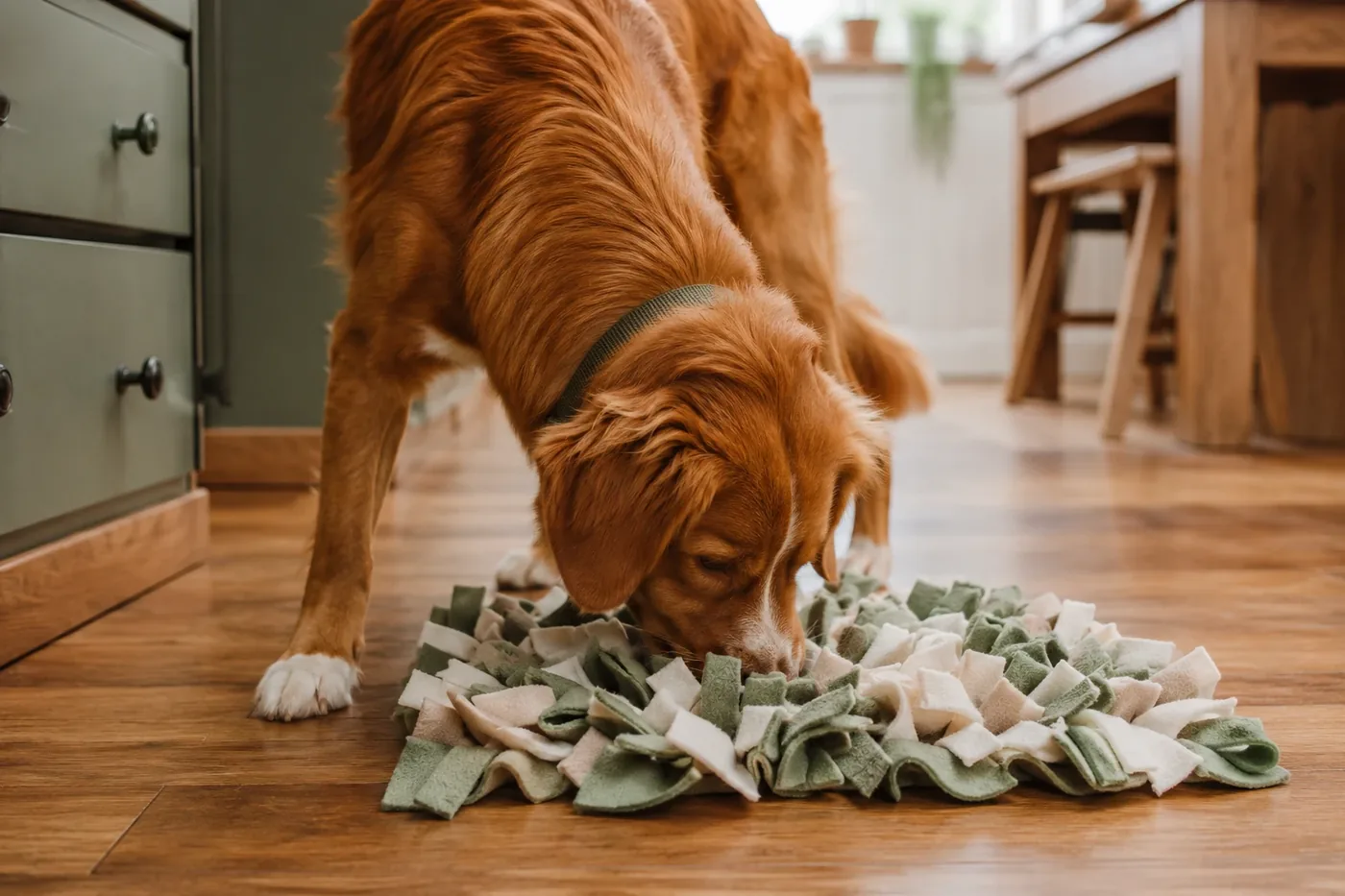
The classic snuffle mat is a rubber mat with holes — a sink mat or garden mat works — with strips of old fleece knotted through every hole until the surface is a dense, grassy shag. Cut strips a few centimetres wide and about the length of your hand, knot one through each hole, and keep going until you cannot see the base. Sprinkle food over the top and ruffle the strips so pieces fall down among them.
No mat to hand? A cardboard box loosely filled with scrunched packing paper and a sprinkle of dry food is a quick, recyclable version of the same idea.
The ground rules: supervision, guarding, hygiene, portions
Supervise every session
Stay nearby while your dog forages. Towels, fleece, and paper smell of food after a few uses, and some dogs move from sniffing to chewing to swallowing surprisingly fast. If your dog has ever eaten fabric, or shreds soft things and swallows the pieces, skip the towel and fleece options entirely — scatter feed on grass or use the muffin tin under close watch instead. If you think your dog has swallowed fabric or paper, call your vet.
Pick the mat up between sessions rather than leaving it down all day. A mat that appears, gets enjoyed, and disappears stays interesting — and stays out of chewing range.
Take guarding seriously
Most dogs forage happily with a person pottering nearby. But if your dog goes stiff over the mat, freezes, stares hard, or growls as you approach, do not reach in and do not test them. Calmly toss a few treats well away from the mat, pick it up once your dog has moved off, and pause all food games.
Guarding responds well to qualified, reward-based help and badly to confrontation. Treat it as the red-flag signal it is and get professional support before playing food games again.
Keep it clean
Food residue and slobber build up quickly. Machine-wash fleece mats and towels regularly and let them dry fully before the next use, wash the muffin tin as normal washing-up, and recycle the box-and-paper version once it has been well snuffled. A damp, stale mat is not a treat for anyone.
It comes out of the daily ration, not on top
Foraging food is not extra food. Measure your dog's normal daily amount and use part of it for scatters and snuffle games, keeping the day's total the same — food-based enrichment is a common, sneaky route to weight gain otherwise.
If your dog is on a special or restricted diet, or has a sensitive stomach, ask your vet what suits food games before you start. Slower, calmer eating is one of the small ways meals and mood interact — there is more on that in the dog gut–brain connection.
What not to do
Do not:
- leave any dog alone with a fabric or paper foraging game, even a normally reliable dog
- offer towel or fleece options to a dog who eats fabric or shreds soft toys and swallows the pieces
- run food-finding games with multiple dogs loose together — separate rooms, separate games
- reach into the mat, hover over your dog, or take food back to "test" their tolerance
- push your dog's nose into the mat or hold them at it — interest has to be voluntary
- scold, grab at, or punish a dog who growls over food, and never use shock, prong, or choke collars, spray bottles, or rattle cans around feeding — growling is information that says get qualified help
- scatter on lawns recently treated with chemicals, or anywhere you have not checked first
- add foraging food on top of full meals — take it out of the daily ration instead
How this connects to other pages
Food-finding games are one branch of the bigger picture in dog enrichment basics. Once your dog is a confident forager, a natural next step is introducing a puzzle feeder, which adds problem-solving on top of the sniffing. And on housebound days, these games pair beautifully with tiring out a dog without a walk and rainy-day indoor games.
Educational disclaimer
The information on this page is provided for general educational purposes only. It is not veterinary advice, a behavioural diagnosis, or an individualised training programme, and nothing here has been personally tested on or guaranteed for your dog. Every dog is different, and what suits one may not suit another.
If you have any concern about your dog's health, comfort, or behaviour — especially guarding food, swallowing non-food items, or a sudden change around meals — please consult a veterinarian, a certified positive-reinforcement trainer, a certified behaviour consultant, or a veterinary behaviour professional. When in doubt, stop the games and get qualified support.
Sources and further reading
These sources support the enrichment and welfare guidance used on this page. This page is educational only and is not a substitute for veterinary or qualified behaviour support.
- Dogs Trust — How to make a snuffle mat for your dog
- Dogs Trust — Enrichment activities to keep your dog entertained
- RSPCA Australia Knowledgebase — Why is enrichment important for dogs?
- RSPCA Australia Knowledgebase — How can I create low-cost DIY enrichment for my cat or dog?
- American Kennel Club — How snuffle mats can help your dog's brain stay active