Rainy-day indoor dog games with no equipment
Rain has a way of cancelling a dog's whole social calendar. The walk is off, the garden is a bog, and by mid-afternoon you have a restless dog patrolling the hallway looking for a project. The good news is that ten minutes of sniffing and searching can settle many dogs more thoroughly than a soggy lap of the block ever would.
Every game on this page uses things you already own — kibble, a towel, a cardboard box, a few mugs, and your own ability to hide behind a door. Nothing to buy, nothing to build, and all of it calm and reward-based. This guide is for ordinary, healthy dogs on an ordinary wet day; if your dog's behaviour has changed suddenly, or something about them is worrying you, start with dog behaviour red flags instead of a games list.
Safety note
This article is educational only. It is not veterinary advice, a diagnosis, or an individualised training plan.
These games are for everyday boredom on days you cannot get out — they are not a treatment for behaviour problems. If your dog stiffens, stares hard, or growls when you or another pet comes near their food or toys, skip the food games and get qualified help rather than practising around it. A sudden behaviour change, signs of pain, illness or injury, severe fear, panic, aggression, or ongoing distress may need a veterinarian, a certified positive-reinforcement trainer, a certified behaviour consultant, or a veterinary behaviour professional. What discomfort can look like is covered in signs of pain in dogs, and when a shift in mood matters is covered in sudden dog behaviour change.
Why sniffing beats pacing
Dogs do not tire out through leg-work alone. Searching for food asks a dog to concentrate, and concentration is genuinely tiring in a way that wandering from room to room is not. Many dogs nap harder after ten minutes of nose-work than after a rushed, rain-soaked walk.
If you want the background on why mental outlets matter so much, dog enrichment basics explains it, and if the weather has ruled out exercise for the whole day, tiring out your dog without a walk turns these ideas into a full day plan. This page is simply the games.
Seven games using nothing you don't already own
1. Find-it with kibble
The simplest game in existence. Show your dog a piece of kibble, say a cheerful "find it," and toss it a metre away so they see it land. Repeat until the phrase clearly means food is on the floor somewhere.
Then make it a search: scatter a small handful across the kitchen floor while they watch, and let them hoover it up. Over the following days, scatter into a rug, around chair legs, or while they wait in another room.
Use part of their normal meal rather than extra food. If your dog loves this one, the fuller version lives at snuffle mats and scatter feeding.
2. Which-hand
Hide a smelly treat in one fist behind your back, then hold both closed fists out at nose height. Most dogs will sniff, then nudge or paw at one hand; if they pick the right one, open it flat and let them take the treat.
If they pick the empty one, show them it is empty — no fuss, no "wrong" — and play again. Keep your hands still and let their nose do the work. This is a sniffing game, not a test.
3. Hide-and-seek
Ask your dog to wait, or have someone gently hold their harness, while you disappear somewhere easy — behind a door, beside the sofa. Call their name once, brightly, and let them come and find you.
When they do, throw a small party: warm praise, a treat, a few seconds of play. Start almost insultingly easy and build up to other rooms. Played this way it doubles as recall rehearsal, and it pairs beautifully with simple recall practice.
4. The towel burrito
Lay an old towel flat, sprinkle kibble along it, and roll it up loosely. Your dog unrolls it with nose and paws to free the food, and as they get slick at it you can roll tighter or fold the ends in.
Supervise this one, and skip it entirely if your dog is more interested in eating the towel than the kibble.
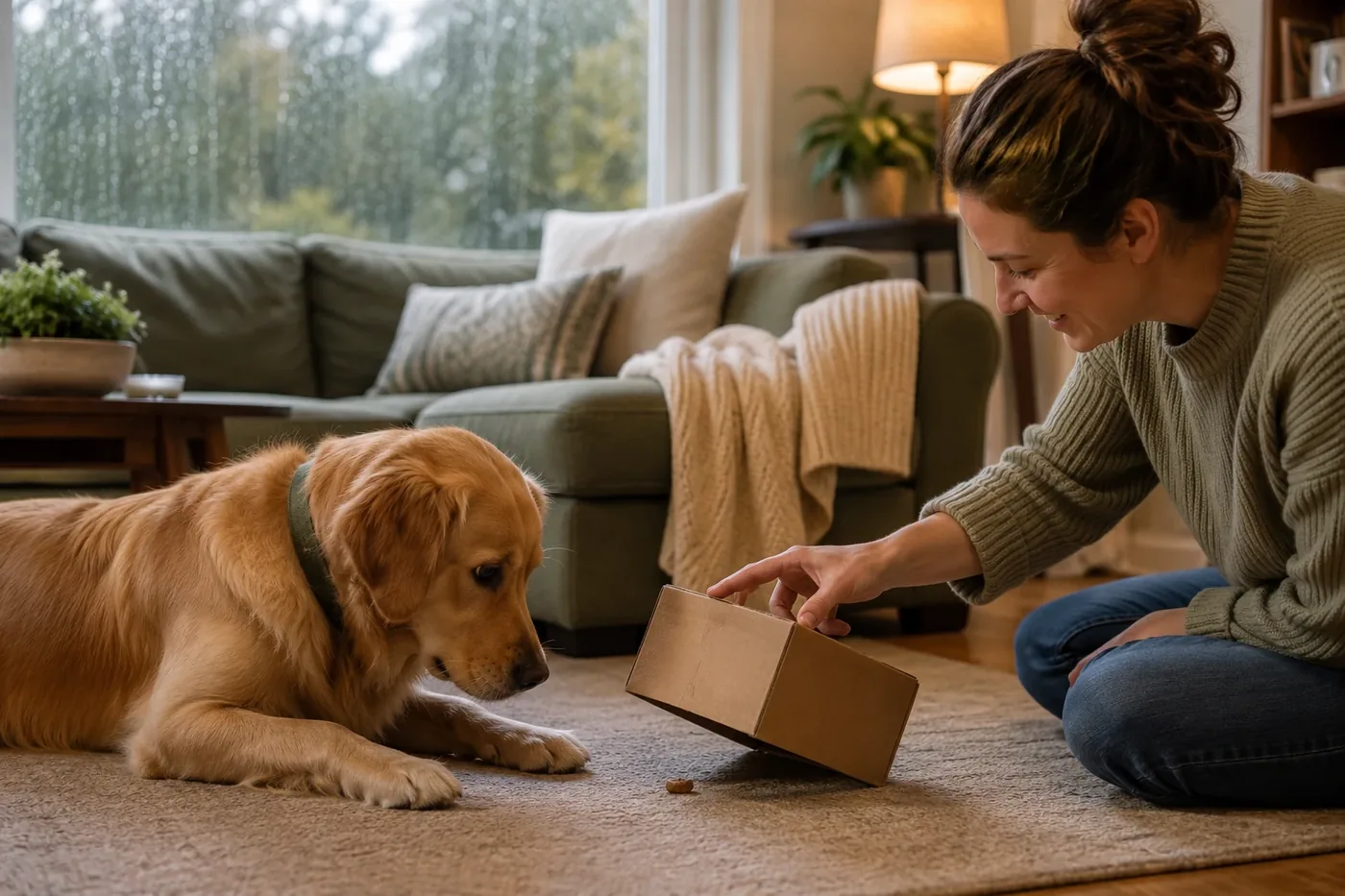
5. Cardboard-box search
Gather two or three empty boxes from the recycling, drop treats into one, and let your dog investigate the lot. Scrunched-up packing paper inside adds a lovely rustling layer of difficulty.
Remove tape and staples first, and accept in advance that some dogs will celebrate by shredding the box. That is allowed — it was recycling anyway.
6. Cup shuffle
Place two or three mugs upside down on a rug and let your dog watch you hide a treat under one. Slide the mugs around slowly, then invite them to choose; when they nose or paw the right one, lift it and let them eat.
Heavier mugs skid less than plastic cups. Keep the shuffling slow and let your dog win often — a dog who keeps losing stops playing.
7. Name-an-object retrieve
This one is for dogs who love to carry things. Hold up a favourite toy, name it — "duck" — and reward your dog for touching it, then holding it, then bringing it. Once "duck" is solid, ask for it from across the room, then from among other toys.
It is a genuine thinking task and best suited to keen, confident retrievers. Keep it light and stop after a few wins; it is a game, not a drill.
Keep sessions short and calm
- Five to ten minutes is plenty. One or two games per session, once or twice a day, beats an hour-long marathon.
- Stop while your dog is still keen. Ending on enthusiasm is what makes tomorrow's game exciting.
- Keep your energy low. Quiet praise and slow movements — the goal is a satisfied dog, not a wound-up one.
- Budget the food. Take game kibble and treats out of the day's normal ration, and if your dog is on a special diet, ask your vet what is fine to use.
After the last game, many dogs settle beautifully with something safe to chew or lick. If yours finds the off-switch hard to locate, teaching a calm settle is the companion skill to all of this.
Adjusting for your household
More than one dog
Food games and multiple dogs need managing. Even best friends can find competition over scattered food stressful, so play these games one dog at a time, with the others behind a door or baby gate with something of their own to enjoy.
If you ever notice stiffening, hard stares, or growling between your dogs around food, stop the food games and read dog behaviour red flags — tension over food is something to get qualified help with, not to train through alone.
Slippery floors
Hard floors and excited paws are a bad mix. Skidding into a cupboard can sour the game — and for an older dog it can mean a real injury — so play on carpet or a rug, or lay a couple of bath mats down as a designated game zone.
Tossed-kibble chasing is the main culprit. On slick floors, choose the towel burrito or the box search instead, since the dog stays roughly in one place.
Puppies and seniors
Puppies can play nearly everything here in tiny, easy versions: two-second waits, a one-box search, kibble scattered on a mat rather than across a room. Keep sessions to a couple of minutes and stop well before the zoomies take over.
Older dogs are often the biggest fans of sniffing games, because nose-work is gentle on stiff bodies. Keep everything at floor level, skip anything with quick turns, and if you are unsure how much activity suits an older dog's joints, ask your vet first.
When "no thanks" might mean something
Most dogs learn these games within a session or two. A dog who repeatedly walks away, quits early, or refuses food they normally enjoy is telling you something, and it is worth listening.
Sometimes the answer is simple: the game is too hard, the room too busy, the treats too boring. But a dog who used to love these games and has gone off them, or who avoids the physical parts — reaching into a box, pawing at a cup, unrolling a towel — may be uncomfortable or in pain. Signs of pain in dogs covers what that can look like, and anything sudden or out of character deserves a conversation with your vet before any more training.
What not to do
Do not:
- force a dog into a game — no pushing them toward the box or holding them at the towel; play only counts as play when it is voluntary
- scold wrong guesses — an empty hand or a wrong cup is part of the game, never a mistake to correct
- use shock, prong, or choke collars, leash corrections, shouting, or any "alpha" or dominance methods — games and intimidation cannot share a room
- run food games with several dogs loose together, or ask dogs to compete for the same scatter
- tease — endless shuffling, snatched-away treats, or unwinnable searches teach a dog that the game is rigged
- play chase-the-kibble games on slippery floors, especially with puppies and older dogs
- pile game treats on top of full meals — use part of the daily ration instead
How this connects to other pages
These games are the rainy-day corner of a bigger picture. Dog enrichment basics explains why this kind of outlet matters every day, not just wet ones, and tiring out your dog without a walk builds the games into a plan for a whole housebound day. When find-it becomes a favourite, snuffle mats and scatter feeding shows how to grow it into a proper mealtime routine — and after the fun, a calm settle helps your dog switch off again.
Educational disclaimer
The information on this page is provided for general educational purposes only. It is not veterinary advice, a behavioural diagnosis, or an individualised training programme, and nothing here has been personally tested on or guaranteed for your dog. Every dog is different, and what suits one may not suit another.
If you have any concern about your dog's health, comfort, or behaviour — especially reluctance to move or play, tension around food, or any sudden change — please consult a veterinarian, a certified positive-reinforcement trainer, a certified behaviour consultant, or a veterinary behaviour professional. When in doubt, stop, give your dog space, and get qualified support.
Sources and further reading
These sources support the enrichment ideas and welfare boundaries used on this page. This page is educational only and is not a substitute for veterinary or qualified behaviour support.