
How to use a long line for sniffing and recall
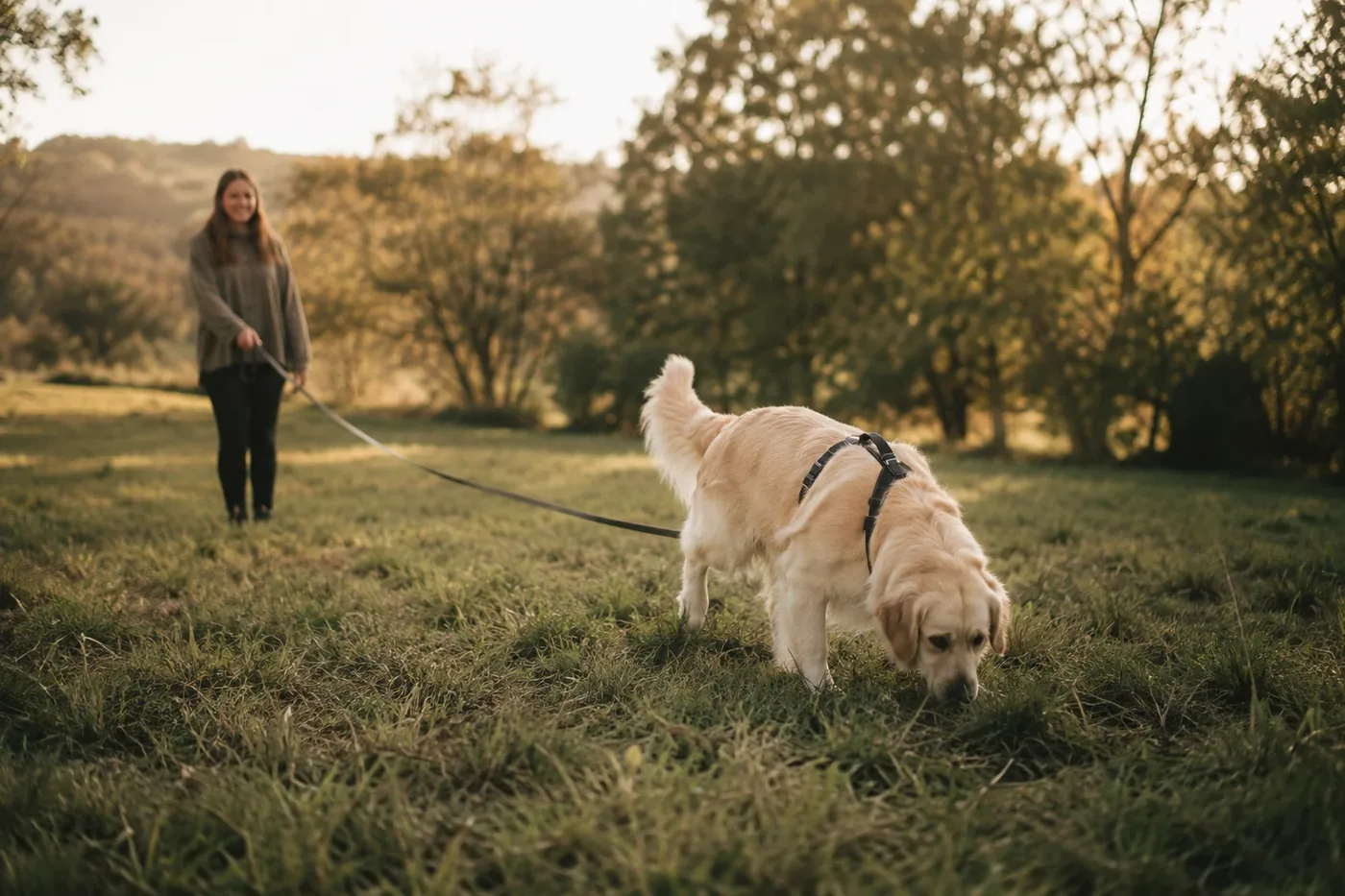
A long line is simply a long training lead — a length of lightweight line that clips to your dog's harness and lets them wander, sniff, and explore much further than an ordinary lead allows, while you keep hold of the other end. It is one of the simplest, kindest pieces of walking gear there is, because it gives a dog real freedom to be a dog without ever letting them out of your care.
Used well, a long line bridges the gap between a short lead and full off-lead freedom. It lets your dog follow their nose across a field, take their time at an interesting scent, and practise coming back to you — all in places where letting them off completely would be unsafe, against the rules, or simply not sensible yet. This guide covers what a long line is, how to pick one, and how to use it calmly and safely.
This is an everyday enrichment and training guide for confident, healthy dogs on quiet walks. A long line is not a fix for strong lunging, reactivity, panic, or any sudden change in behaviour — if you are seeing those, work through dog behaviour red flags and get qualified, in-person help before heading out with a long line.
The quick answer
A long line is a long lead — often 5 to 10 metres — clipped to a well-fitted harness, never a collar. It lets your dog sniff and practise recall with freedom while you keep them safe.
- Clip it to a Y-shaped harness, not a collar, to protect the neck.
- Let it trail or hold it loosely; never let it snap tight.
- Use it in open, safe spaces away from roads and crowds.
- Wear gloves to avoid rope burn, and never wrap it around your hand or tie it to yourself.
Safety note
This article is educational only. It is not veterinary advice, a diagnosis, or an individualised training plan.
A long line always attaches to a well-fitted harness, never to a flat, slip, or choke collar. A dog who reaches the end of the line at speed on a collar can be jerked hard by the neck, which risks real injury. A long line is also not the right tool for a dog who lunges powerfully, pulls you off balance, or reacts strongly to other dogs, people, or wildlife — those situations need a certified positive-reinforcement trainer or behaviour professional first. If your dog shows fear, panic, aggression, sudden behaviour change, or signs of pain, please read dog behaviour red flags and signs of pain in dogs and seek help before continuing.
What a long line is
A long line is a single length of lead, much longer than an everyday walking lead, with a clip at one end for your dog's harness and a handle or a knot at the other for you. That is the whole design. There is no retracting mechanism and no tension pulling your dog back — the slack simply trails along, and you gather it up or let it out as needed.
Think of it as a safety tether that happens to be long. Your dog gets to move, sniff, and range around almost as freely as they would off-lead, but you can always gently reel them in, stop them reaching a road or a stranger, and stay in control of where the walk goes.
Why a long line is useful
Sniffing is not idle time for a dog — it is how they read the world, and it is genuinely calming. A long line gives your dog the space to do plenty of it, which is why it pairs so naturally with decompression and sniffari walks, where the whole point is to let the nose lead.
A long line is helpful when:
- Off-lead is not safe or not allowed. Many parks, paths, and open spaces have leash rules, livestock, or roads nearby, and a long line keeps you within them while still giving freedom.
- Your dog is still learning recall. It lets you practise coming back over a real distance without the risk of your dog simply running off.
- You want calmer, richer walks. Time spent sniffing and exploring tires a dog out mentally, which fits neatly alongside other enrichment basics.
- You are building trust with a newer dog. It offers a safe middle step between the short lead and full freedom.
Choosing a long line
You do not need anything fancy or branded. A few generic qualities matter far more than any label:
- A length that suits your space. A shorter line gives you more control in tighter or busier spots; a longer one suits wide-open fields. Start on the shorter side while you both get used to handling it.
- An easy-to-handle material. A light, soft line that does not soak up water or dig into your hands is much pleasanter to manage than a stiff or bulky one.
- A secure, lightweight clip. It should fasten firmly to a harness ring without being so heavy that it drags on your dog.
- A well-fitted harness to attach it to. This is the non-negotiable part. The line goes on a comfortable, properly fitted harness — never a collar of any kind.
Using a long line safely
A long line is easy to use, but the trailing length does take a little practice to manage without tangles or rope burn. A few habits keep it safe for both of you.
Before you head out
Fit the harness snugly and check the clip is secure. It is worth wearing a pair of light gloves, because a line running quickly through bare hands can give a nasty friction burn. Keep any spare food rewards handy so you can pay your dog well for checking in and coming back.
Managing the slack
Let out only as much line as you need, and gather the rest in loose folds in your hand rather than letting it all trail at once. Keep an eye on where the line runs so it does not wrap around your dog's legs, your own legs, or a passer-by. If your dog circles you or loops around a tree or post, calmly walk them back out of it rather than pulling.
Never let your dog hit the end at speed
The one thing to avoid is a dog sprinting to the full length and being snapped to a stop. Even on a harness, a sudden hard jolt is unpleasant and can hurt. Stay aware of how much line is out, and gently gather it in as your dog nears the end, or call them back before they run out of room. Smooth and slack is the goal — never a taut, jerking line.
Where to use a long line
Choose quiet, low-traffic places with plenty of room and good visibility — an empty field, a wide quiet path, or ideally a securely enclosed space. Open ground with few people, dogs, or hazards means you are not constantly reeling your dog in, and there is far less to wrap the line around.
Avoid busy paths, roadsides, tight spaces, and crowds, where a long line becomes a trip hazard and gives you too little time to react. And always check the local rules for where you are walking, since leash laws and on-lead areas vary from place to place.
Pairing a long line with recall and sniffing
A long line is at its best as a bridge to reliable recall. Because your dog can range out and still be safely connected, you can call them back from a genuine distance, reward generously when they come, and let them head off to sniff again as a bonus. That pattern — freedom, a happy return, more freedom — is exactly what builds a recall your dog wants to perform. Work through the steps in simple recall practice with the line on before you ever rely on it off-lead.
It also transforms ordinary walks into slower, richer outings. Let your dog set the pace and follow interesting scents on a loose line, as described in sniffari walks. The gentle, no-pulling handling you use on a long line is the same calm approach behind loose-leash walking without corrections — you are guiding, never yanking.
When a long line is not the answer
A long line is an everyday enrichment tool, not a management solution for serious behaviour. If your dog lunges hard, pulls you off your feet, reacts strongly to triggers, or has ever bitten or shown real aggression, a long line can actually make things riskier — for you, your dog, and others nearby. Those situations call for a certified positive-reinforcement trainer or a qualified behaviour professional, working in person. Start with dog behaviour red flags to recognise what needs that kind of help.
What not to do
Do not:
- attach a long line to a flat, slip, or choke collar — always use a well-fitted harness to protect your dog's neck
- let your dog build up speed and hit the end of the line, which can jolt and hurt them even on a harness
- use a long line to "correct" your dog with a jerk or a pull — that is never part of a kind approach
- use shock, prong, or choke collars, leash corrections, or any dominance-based method alongside it
- use a long line in busy, crowded, or roadside areas where it becomes a trip and tangle hazard
- rely on a long line to manage strong lunging, reactivity, or aggression instead of getting professional help
- leave your dog unsupervised on a long line, or let the line trail unattended where it can snag or wrap
How this connects to other pages
A long line is one of the friendliest ways to add freedom and sniffing to a walk, so it sits close to the wider enrichment basics. It is the safe way to run sniffari walks and to build a dependable recall through simple recall practice. The calm, correction-free handling it relies on is the same spirit as loose-leash walking without corrections. And if anything about your dog's behaviour worries you, dog behaviour red flags will help you decide when to pause and seek support.
Common questions
What is a long line used for?
A long line gives a dog room to sniff, explore and practise recall in open space while still under your control. It is a gentle bridge between on-lead walking and off-lead freedom, useful while a reliable recall is still being built.
Should a long line attach to a collar or a harness?
Always a well-fitted harness, never a collar — a dog hitting the end of a long line on a collar can jolt the neck. A Y-shaped harness spreads any pressure across the body and is much safer.
How long should a long line be?
Many owners start around 5 metres and move up to 10 metres as they get comfortable managing it. Longer lines give more freedom but are harder to handle; pick the length and space you can keep safe and untangled.
Are long lines safe?
Used thoughtfully, yes — but the line can burn hands, tangle legs, or catch on obstacles. Use a harness, wear gloves, keep it away from roads and crowds, never wrap it around your hand or tie it to yourself, and let it trail loosely rather than snapping tight.
Educational disclaimer
The information on this page is provided for general educational purposes only. It is not veterinary advice, a behavioural diagnosis, or an individualised training programme, and nothing here has been personally tested on or guaranteed for your dog. Every dog is different, and what suits one may not suit another.
If you have any concern about your dog's health, comfort, or behaviour — especially fear, reactivity, or aggression on walks — please consult a veterinarian, a certified positive-reinforcement trainer, a certified behaviour consultant, or a veterinary behaviour professional. When in doubt, keep walks short and calm, choose a quiet spot, and get qualified support.
Sources and further reading
These sources support the humane-training and welfare boundaries used on this page. This page is educational only and is not a substitute for veterinary or qualified behaviour support.