
Teaching “Wait” and “Stay” for Everyday Safety
“Wait” and “stay” are two of the most genuinely useful cues a pet dog can learn. They are not party tricks. They are everyday safety skills: a dog who pauses at the front door, holds still while you open the car, or stays put while you carry hot food across the kitchen is a dog who is easier to keep safe and calm.
The good news is that both cues are taught the same gentle way as everything else on this site — with rewards, tiny steps, and a clear signal that says “you can move now.” There is no need for force, leash corrections, or stern voices. For the thinking behind this approach, read humane dog-training principles, and for what this site does and does not cover, read what this dog-training site covers.
This guide is for ordinary, healthy dogs and puppies learning self-control in everyday situations. It is not a fix for fear, panic, or aggression, which need different and more individual help.
Safety note
This article is educational only. It is not veterinary advice, a diagnosis, or an individualized training plan.
Never rely on a “wait” or “stay” cue alone to keep a dog out of danger. Cues take time to become reliable, and even a well-trained dog can break one under stress. Keep using physical safety — a lead, a closed door, a secure garden, or a barrier — near traffic, water, or anything genuinely risky. If a dog suddenly struggles to hold still, seems stiff, reluctant to move, or uncomfortable when changing position, that can be a physical issue rather than a training gap; read signs of pain in dogs and, if it appeared out of nowhere, sudden dog behavior change. If you are ever unsure whether a problem needs professional help, check the dog behavior red flags.
Wait versus stay: what is the difference?
People often use these two words interchangeably, but it helps to keep them apart in your own head, because they do slightly different jobs.
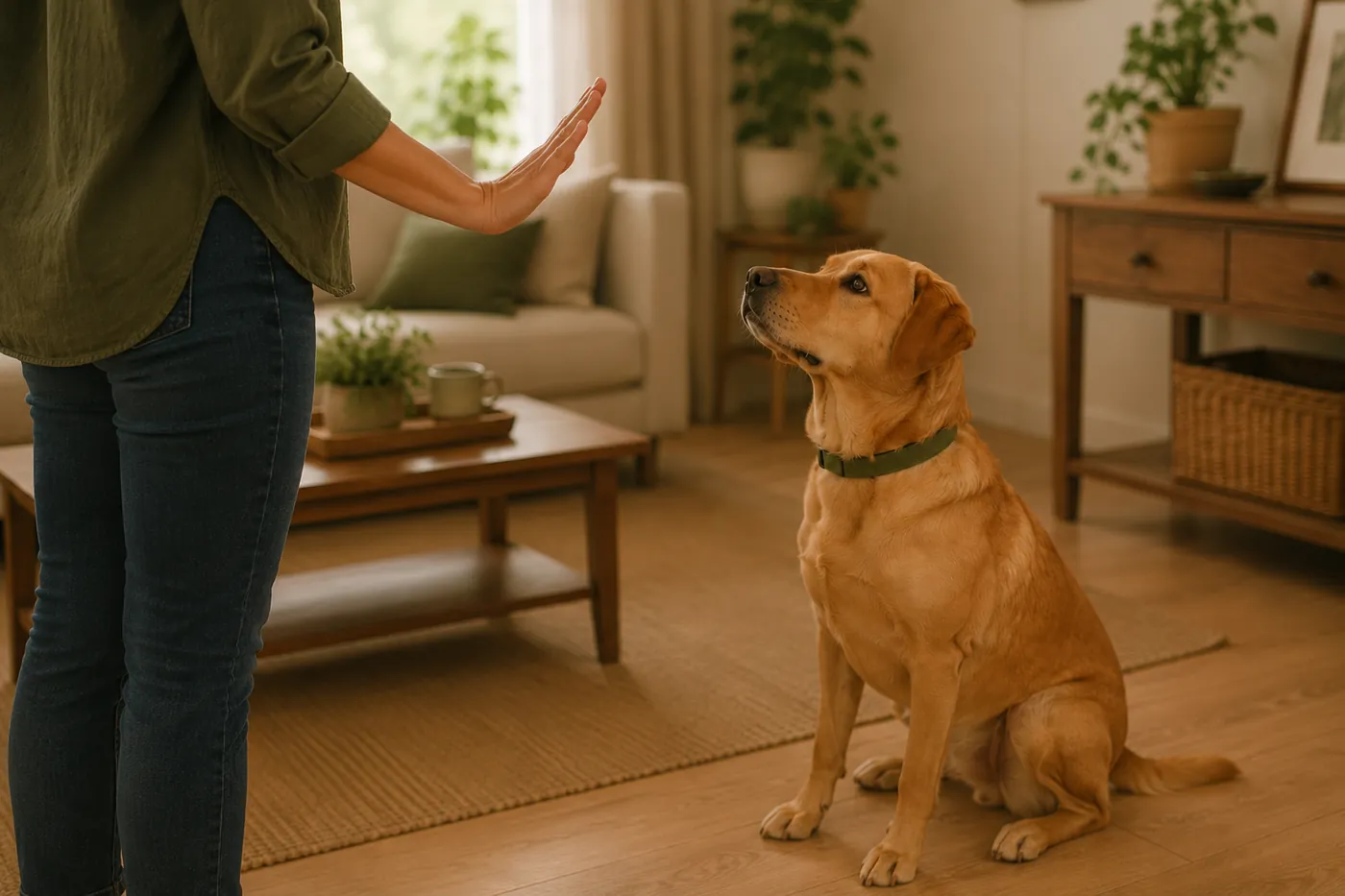
“Wait” means a brief pause. It says “hold on a moment” rather than “freeze in this exact spot.” You use it at thresholds: pausing at the front door, before the food bowl goes down, at the kerb, or before jumping out of the car. The dog does not have to hold a particular position — it just needs to stop and not barge ahead until you say it is fine to go.
“Stay” means hold this position until I release you. The dog stays sitting or lying down, in the same place, even if you step away, until you give a clear release word. Stay is about duration and stillness, which is why it usually takes a little longer to build.
You do not have to teach both, and you do not have to use these exact words — pick words you will remember and use them consistently. Many owners find “wait” alone covers most daily needs, and add “stay” later for longer holds.
When this guide is a good fit
This guide may help if:
- you have a healthy dog or puppy and want calmer, safer everyday moments
- your dog rushes ahead at doors, the car, or the food bowl
- you want a clear, reward-based way to build self-control in small steps
- you already practise a few basic cues and want to add useful safety skills.
This guide is not enough if:
- your dog bolts in panic, freezes in fear, or reacts aggressively when approached
- the dog seems unable to hold still because of stiffness, soreness, or trouble settling at all
- the behaviour you are worried about is sudden, intense, or out of character
- you need a dog to be reliable around real danger right now, before training has had time to work.
In those situations, use physical management first and speak to a veterinarian or a qualified positive-reinforcement behaviour professional. Fear, panic, and aggression in particular are red flags that need proper help rather than more drilling of a cue.
The three D’s: how stay actually grows
Both cues, and stay especially, are built by stretching three things — but only ever one at a time:
- Duration — how long the dog holds before being released.
- Distance — how far you can move away.
- Distraction — what is going on around the dog.
The most common mistake is raising two at once: stepping further away and staying out longer, for example. When that happens the dog usually breaks, gets confused, and learns less. If you ever increase one D, drop the other two right back down to easy. Make it your job to keep the dog succeeding, not to test where it fails.
Always finish with a release cue
A release word is the single most important part of teaching wait and stay, and the part most people skip. The dog needs one clear signal that means “you can move now.” Without it, the dog has to guess when the exercise is over, which makes holds shaky and stressful.
Pick a short, cheerful word you would not say by accident — many people use “okay,” “free,” or “break.” The rule is simple: the dog stays put until it hears that word, every single time. You give the cue, the dog holds, you say the release word, and only then does the dog get to move and collect any extra reward. Be consistent and the release word quickly becomes a reliable on-off switch.
Teaching “wait” step by step
Wait is quick to teach because the pause is short. Start somewhere calm and boring, like a quiet room, before you ever try it at a real door.
Step 1: the food-bowl pause
With your dog in front of you, hold the food bowl (or a treat) and start to lower it. The instant your dog surges forward, calmly lift it back up — no scolding, just pause. The moment the dog hesitates or holds still, say your release word and let them have it. Within a few repetitions most dogs work out that stillness, not lunging, makes the food arrive.
Step 2: add the word
Once the dog reliably pauses, start saying “wait” just before the brief hold, then release. You are simply attaching a name to something the dog is already doing.
Step 3: take it to doorways
Move to an interior door. Say “wait,” begin to open it a crack, and if the dog holds, release them through. If the dog pushes forward, calmly close the door and try again with a smaller movement. Build up to the front door last, always with a lead on for safety until the cue is solid. This is also one of the best tools against door-dashing, where a pause at the threshold can prevent a dog slipping outside.
Teaching “stay” step by step
Stay builds on a position the dog already knows, such as a sit or a down. If those are still new, work on the basics first; a puppy’s first cues covers how to teach name, sit, and down kindly.
Step 1: reward stillness for one second
Ask for a sit. Count one second in your head, then calmly reward while the dog is still sitting, and give your release word. That is the whole first rep: hold, reward, release. Repeat several times so the dog learns that staying put pays.
Step 2: build duration
Slowly stretch the hold — two seconds, then three, then five — rewarding before you release. If the dog breaks, you have gone too fast; simply make the next rep shorter and easier. Keep your feet still at this stage; you are only working on duration.
Step 3: add a little distance
Now drop duration back to something easy and take one small step back, then immediately step in and reward, then release. Build to two steps, then a few. The dog learns it can hold even while you move, but only because you made each increase tiny.
Step 4: add gentle distractions
Once duration and distance are comfortable, practise with mild distractions — someone walking past, a toy on the floor, a knock at the door — while keeping the hold short and the distance small. Real life is full of distractions, so this is what makes a stay genuinely useful.
Step 5: practise in new places
A stay learned in the kitchen is not automatically a stay in the garden or on a walk. Repeat the easy early steps in each new setting. Dogs do not generalise the way people expect, so a little fresh practice in each location goes a long way.
A simple first-week starter plan
Keep sessions short — a few minutes, a few times a day, ending while the dog is still keen.
- Days 1–2: teach the food-bowl “wait” and choose your release word. Reward every calm pause.
- Days 3–4: add the word “wait” and start one-second “stay” reps in a quiet room.
- Days 5–6: stretch the stay to a few seconds, then add one or two steps of distance. Try “wait” at an interior door.
- Day 7: add one mild distraction to short, easy holds, and practise “wait” at the front door with a lead on.
If any day feels shaky, repeat it rather than pushing on. Steady, boring success beats fast progress that falls apart.
Troubleshooting
“My dog breaks the stay the moment I step away.”
You have raised distance before duration was solid, or stretched too far too soon. Go right back to rewarding a still dog with your feet planted, then add just one small step at a time. A broken stay is information, not disobedience — it tells you to make the next rep easier.
“What do I do when my dog gets up before I release them?”
Simply, calmly reset. Lead them back, ask for the position again, and make the next attempt shorter so they can succeed. Never tell them off for breaking — punishment makes dogs reluctant to hold still at all, because staying put starts to feel risky.
“My dog waits beautifully at home but ignores me at the park.”
That is normal. A new, exciting place is a big jump in distraction. Drop your expectations right back to one-second holds at no distance and rebuild gently in that setting. With practice the cue travels with you.
“Should I use a stern voice or repeat the cue if my dog moves?”
No. Repeating “stay… stay… STAY” just teaches the dog to wait for the loud version. Say the cue once in a normal voice. If the dog cannot hold it, the exercise was too hard, not the volume too low. This is the same idea behind getting a dog to listen without yelling.
“My puppy is too wriggly to hold any position.”
Young puppies have very little self-control yet, and that is perfectly normal. Start with one-second holds, reward fast, and keep sessions tiny. Teaching a puppy to settle calmly first often makes stay much easier later.
What not to do
Do not:
- push, pull, or hold the dog down to keep it in position
- use leash corrections, a raised voice, or startling noises when it breaks
- scold or punish a broken stay — just make the next rep easier
- raise duration, distance, and distraction at the same time
- forget the release word, leaving the dog to guess when it is free
- rely on the cue alone near traffic, water, or other real danger.
Force and intimidation may produce a frozen, worried dog, but they do not build the calm, willing hold you are after — and they damage trust. A reliable stay comes from the dog choosing to stay because it pays, not from fear of what happens if it moves.
How this connects to other pages
Wait and stay sit alongside the rest of a calm, well-mannered routine. A reliable recall and a solid wait work as a team near roads and open spaces, and a good guard against door-dashing often starts with a pause at the threshold. Folding short practice into a simple daily training routine keeps the skills fresh, while teaching a dog to settle calmly builds the self-control these cues rely on. For the overall philosophy, see humane dog-training principles, and if you are ever unsure whether a problem needs professional help, check the dog behavior red flags.
Educational disclaimer
This page provides general educational information about teaching ordinary self-control cues to healthy dogs and puppies. It is not veterinary advice, a diagnosis, or an individualized behavior plan.
If the dog shows fear, panic, aggression, sudden difficulty holding or changing position, signs of pain or illness, or any sudden change in behavior, contact an appropriate professional such as a veterinarian or a qualified positive-reinforcement behavior professional. Never rely on a trained cue alone to keep a dog safe around genuine hazards.
Sources and further reading
These sources support the humane-training and welfare boundaries used on this page. This page is educational only and is not a substitute for veterinary or qualified behavior support.