
How to Get Your Dog to Listen Without Yelling
If you find yourself repeating a cue louder and louder while your dog stares off in the other direction, you are not alone. Many owners reach for volume when a dog “ignores” them — and many feel guilty about it afterwards. The good news is that listening is something you can build calmly, and yelling is almost never the thing that fixes it.
A dog who does not respond is usually not being defiant, stubborn, or “dominant.” More often the dog is distracted, too far over their head in a busy environment, not very motivated in that moment, or has simply never practised the cue in that situation. Getting your dog to listen is really about becoming worth listening to, and about teaching cues so well that responding feels easy.
This guide is for ordinary, healthy dogs whose attention you would like to improve. For the methods behind it, read humane dog-training principles, and for what this site does and does not cover, read what this dog-training site covers.
The quick answer
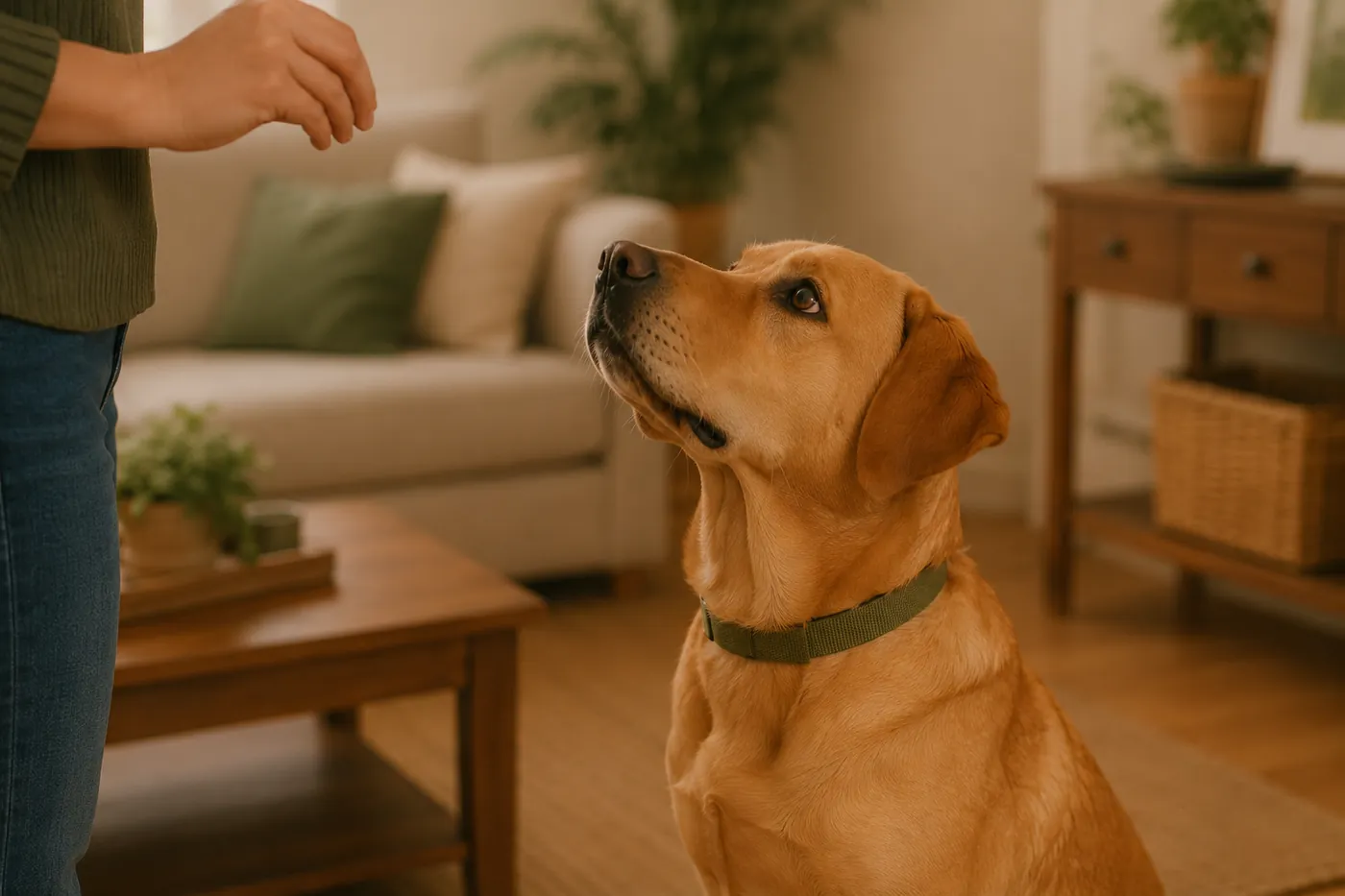
To get your dog to listen without yelling, make attention pay: reward every voluntary check-in, say each cue once in a calm, friendly voice, and reward the response promptly. Practise in quiet places first, then raise distractions one step at a time — dogs ignore cues because of training or environment gaps, not defiance.
- Reward check-ins: whenever your dog glances at you unprompted, quietly mark it and reward — paying attention to you becomes a habit they offer on their own.
- Say it once: pick one short word per behavior and give it in a normal, friendly voice; repeating or getting louder just teaches your dog the cue means “you have several tries”.
- Raise difficulty gradually: practise in a quiet room, then the garden, then a quiet street — and match better rewards to harder environments.
- Set up wins, not failures: if you would honestly bet your dog cannot respond right now, do not give the cue — manage the moment and train that situation later when it is easier.
Safety note
This article is educational only. It is not veterinary advice, a diagnosis, or an individualized training plan.
A dog who suddenly stops responding to familiar cues is worth a closer look. Reduced hearing, discomfort, or pain can all look like “not listening,” and so can fear or stress. Contact a veterinarian if your dog seems unwell, painful, or distressed, or if a previously responsive dog changes noticeably. If the change came on suddenly, read sudden dog behavior change, and if your dog may be uncomfortable, read signs of pain in dogs. Training should never delay a needed veterinary check.
Why yelling does not work
Raising your voice feels like it should add urgency, but to a dog it mostly adds noise and tension. Understanding why helps you stop reaching for it.
- Yelling raises arousal. An excited or anxious dog finds it harder, not easier, to think and respond.
- It adds noise rather than information. The dog hears that you are upset, but not what you would like instead.
- It can frighten or startle. A scared dog may freeze, avoid you, or shut down — none of which is listening.
- It erodes trust. If you become unpredictable or alarming, your dog has less reason to want to be near you and check in.
It also rests on a misunderstanding. Dogs are not plotting to disobey, and they are not trying to be “the boss.” Modern welfare and veterinary bodies, including the RSPCA, reject dominance-based explanations of dog behaviour. A dog ignoring a cue is showing you a training or environment gap, not a power struggle.
When this guide is a good fit
This guide may help if:
- your dog knows some cues at home but “tunes out” when distracted
- you find yourself repeating cues or getting louder to get a response
- your dog seems more interested in the environment than in you
- you want a calm, reward-based way to build attention and responsiveness.
This guide is not enough if:
- a previously responsive dog suddenly stops listening or seems “away with it”
- there are signs of pain, illness, reduced hearing, or distress
- the “not listening” involves fear, panic, growling, freezing, or guarding
- you feel out of your depth, or behaviour is getting worse rather than better.
In those situations, speak to a veterinarian or a qualified positive-reinforcement behavior professional. If you are unsure whether a problem needs professional help, check the dog behavior red flags.
Make yourself worth listening to
Listening starts long before you give a cue. A dog pays attention to the things that reliably matter to them, so the first job is to become one of those things.
Reward checking in
Whenever your dog glances at you of their own accord — at home, in the garden, on a walk — calmly mark it and reward it. A quiet “yes” and a small treat tells the dog that paying attention to you pays off. Done often, this turns “check in with my human” into a habit your dog offers on their own.
Be the source of good things
Hand-feed part of a meal during a short training game, hide a treat and let them find it after a recall, or start a quick game of tug when they come to you. The more often good things flow from you, the more your dog naturally orients towards you rather than the rest of the world.
Protect the value of your attention
Avoid wearing out cues by repeating them when the dog cannot respond. If your name or “come” is said twenty times a day with no follow-through, those words stop meaning much. Used sparingly and always followed by something good, they stay sharp.
Give cues your dog can actually follow
Half of “not listening” is really “the cue was unclear, or impossible right now.” Clean cue habits remove most of that.
Say it once, clearly
Pick one short word for each behaviour and use it consistently — the same word, by everyone in the household. Say it once in a normal, friendly voice. If the dog does not respond, do not repeat or raise your voice; that simply teaches them that the cue means “you have several tries.” Instead, help them succeed (move closer, reduce the distraction) and try again.
Reward promptly and generously
Mark the moment your dog responds and reward within a second or two, while they are still doing the right thing. Fast, clear rewards build fast, willing responses. For cues that matter, especially recall, keep paying well long after the dog “knows” it — reliability comes from a strong reward history, not from the dog deciding to obey.
Keep your body and tone friendly
Leaning over a dog, staring, or sounding tense can read as pressure and make them hesitate. An upright, relaxed posture, a light voice, and even crouching or turning slightly away can make it far easier for a dog to come to you and engage.
Manage the environment and difficulty
A dog who responds beautifully in the kitchen but not at the park has not become disobedient — they have hit a level they have not practised. Dogs do not automatically “generalize” a cue to every place, so you have to help them.
- Start easy. Practise new cues in a quiet, familiar place with few distractions before expecting them anywhere busy.
- Raise difficulty one step at a time. Add mild distractions gradually — a different room, then the garden, then a quiet street — only moving on when the dog is succeeding easily.
- Match the reward to the challenge. The harder the environment, the better the reward should be. Bland treats at home can become something special outdoors.
- Mind the distance to distractions. If your dog cannot respond near an exciting thing, you are simply too close. Move further away until they can think again, then close the gap slowly over many sessions.
- Set up wins, not failures. If you would honestly bet your dog cannot respond right now, do not give the cue. Manage the moment instead, and train that situation later when it is easier.
A simple starter plan
Step 1: build the check-in habit
For a few days, simply reward your dog every time they look at you, at home and in the garden. No cues yet — you are just teaching that attention pays.
Step 2: add a name response
Say your dog’s name once in a friendly voice. The instant they turn towards you, mark and reward. Practise in short bursts until they whip round happily, then begin practising in slightly busier places.
Step 3: practise one cue properly
Choose one useful cue — a recall or a settle, for example — and train it the same way: say it once, reward promptly, start easy, and raise difficulty slowly. Build that one to reliability before adding more.
Step 4: take it on the road
Once your dog responds well at home, rehearse the same cues in quieter outdoor spots, then gradually busier ones. Keep sessions short, upbeat, and rewarding so listening stays a pleasure, not a chore.
Troubleshooting
“My dog only listens when I have food.”
This usually means rewards have become too predictable. Keep rewarding, but vary what the reward is — sometimes food, sometimes a game, praise, or a sniff break — and reward a little less predictably over time so the dog stays keen without needing to see a treat first. Carry rewards out of sight rather than waving them about.
“He ignores me completely at the park.”
The park is one of the hardest environments there is. Drop back to easier places, raise difficulty in small steps, and use much better rewards outdoors. Until recall is solid, keep your dog safe with a long line rather than risking a cue you cannot back up. See simple recall practice for a calm way to build this.
“She listens to my partner but not to me.”
Often one person has a clearer, calmer cue habit or a richer reward history. Agree on the same words and rules across the household, and make sure everyone rewards promptly. Spend a little one-to-one training time together to build your own value.
“My dog used to listen and now suddenly does not.”
A sudden change deserves attention rather than more training. Reduced hearing, discomfort, pain, or stress can all look like ignoring you. Have a chat with your veterinarian first, and read sudden dog behavior change and signs of pain in dogs.
“I lose my patience and end up shouting.”
It happens to almost everyone. When you feel it building, the kindest and most effective move is to end the session, manage the situation, and try again later when you are both calmer. Shorter, happier sessions beat long, frustrating ones every time.
What not to do
Do not:
- shout, repeat cues endlessly, or get louder when ignored
- use shock, prong, or choke collars, or leash corrections, to “make” a dog respond
- use dominance, “alpha,” or “he knows he’s being naughty” explanations
- startle, intimidate, or stare a dog down to get attention
- punish a dog for coming to you late — that teaches them not to come at all
- expect a cue learned at home to work straight away in a busy place.
Punishment and intimidation tend to raise stress and damage the very relationship that makes a dog want to listen. Calm, rewarding practice does the opposite.
How this connects to other pages
Building attention sits underneath almost everything else on this site. Once your dog is checking in, you can put it to use in recall practice, in loose-lead walking, and when you teach wait and stay. Teaching your dog to settle calmly lowers the arousal that makes listening hard, and a simple daily training routine gives you regular, low-pressure chances to reward responsiveness. For the overall approach, see humane dog-training principles, and if you are ever unsure whether a problem needs professional help, check the dog behavior red flags.
Common questions
Why does my dog ignore me when I call him?
Usually because the situation is harder than anything he has practised, the environment is more interesting than you, or the cue has been worn out by repetition — not because he is stubborn or dominant. Rebuild it: reward voluntary check-ins, say the cue once in a friendly voice, practise in quiet places, and raise distractions gradually with better rewards.
Does yelling at a dog make it listen?
No — yelling adds noise and tension, not information. It raises arousal, which makes it harder for a dog to think and respond; it can frighten a dog into freezing or avoiding you; and over time it erodes the trust that makes a dog want to check in. A calm cue, said once and followed by a reward, works far better.
How do I get my dog to listen around distractions?
Drop back to a level where your dog can succeed. Practise the cue in a quiet room, then the garden, then a quiet street, only moving on when responses come easily — and use much better rewards in harder places. If your dog cannot respond near something exciting, add distance until they can think, and keep recall safe on a long line meanwhile. See simple recall practice.
Why has my dog suddenly stopped listening to me?
A sudden change deserves attention rather than louder training. Reduced hearing, pain, illness, or stress can all look like “ignoring you”, so book a veterinary check first and mention exactly what changed. If the not-listening comes with fear, growling, freezing, or guarding, work with a qualified positive-reinforcement behaviorist too — the dog behavior red flags guide helps you judge when.
Educational disclaimer
This page provides general educational information about building attention and responsiveness in ordinary, healthy dogs. It is not veterinary advice, a diagnosis, or an individualized behavior plan.
If your dog suddenly stops responding, shows signs of pain, illness, or reduced hearing, or displays fear, panic, growling, freezing, or guarding, contact an appropriate professional such as a veterinarian or a qualified positive-reinforcement behavior professional.
Sources and further reading
These sources support the humane-training and welfare boundaries used on this page. This page is educational only and is not a substitute for veterinary or qualified behavior support.
- AVSAB — Humane Dog Training Position Statement
- Dogs Trust — Dog training basics
- Dogs Trust — Positive reinforcement: training with rewards
- RSPCA — How to train your dog
- RSPCA Australia — The view on dominance dog training
- ASPCA — Behavioral help for your pet
- MSD Veterinary Manual — Behavior problems of dogs