
Teach Your Dog to Accept Gentle Handling
Gentle handling is the quiet foundation underneath almost everything else we ask our dogs to tolerate — having their paws lifted, their ears looked at, their collar held, their mouth checked, or simply being touched all over. It sounds like a small thing, but a dog who genuinely feels comfortable being handled is far easier to groom, examine, and care for, and far less likely to be pushed into fear. The goal here is not to make a dog endure touch. It is to help them feel that human hands are safe, predictable, and usually followed by something good.
Many dogs are slightly wary of being touched in certain places, and that is completely normal. Paws, ears, and mouths are sensitive, and a hand reaching toward them can feel like a surprise. The wrong response is to hold the dog still and "get it over with," because that teaches the dog that hands mean being trapped. The kinder, more effective approach is consent-based cooperative care: we go slowly, we watch how the dog feels, and we let the dog opt in rather than forcing the issue.
This guide is for ordinary, healthy dogs learning to feel relaxed about everyday touch. For the reasoning behind everything below — why we reward instead of correct, and why the dog's pace matters — read humane dog-training principles, and for the scope of what we do and do not cover here, read what this site covers.
Safety note
This article is educational only. It is not veterinary advice, a diagnosis, or an individualised training plan.
If your dog reacts to handling with fear or aggression — flinching hard, freezing, growling, snapping, or trying to get away — stop and seek qualified help. Pain is one of the most common hidden reasons a dog dislikes being touched in a particular spot, so a dog who suddenly hates having an ear or a hip handled may be telling you something is wrong. A sudden behaviour change, signs of pain, illness or injury, severe fear, panic, aggression, or ongoing distress may need a veterinarian, a certified positive-reinforcement trainer, a certified behaviour consultant, or a veterinary behaviour professional. It helps to know the wider warning signs in dog behaviour red flags, what discomfort can look like in signs of pain in dogs, and when a shift in mood matters in sudden dog behaviour change. Handling is never worth pushing a frightened dog through.
How dogs learn to enjoy being touched
Dogs are not born understanding that a hand on the paw is harmless. They learn it through experience, and the experiences we give them decide whether touch becomes something they relax into or something they brace against. The single most useful idea in this whole guide is simple: touch predicts good things. When a gentle touch is reliably followed by food or warm praise, the touch itself starts to feel pleasant, because the dog learns to expect what comes next.
A few principles make this work:
- One body part at a time. Work on paws, or ears, or the collar — not all of them in one go.
- Very short sessions. A minute or two is plenty. Stopping early, while the dog is still happy, is what builds trust.
- Touch, then treat — in that order. The touch should come first and predict the treat, not the other way around.
- Watch for consent. A loose, leaning-in dog is saying yes. A dog who turns away, licks their lips, yawns, freezes, or steps back is saying "not right now," and we listen.
The core method: touch, treat, repeat
Start when your dog is already calm and a little hungry, in a quiet room with no distractions. Have small, soft treats ready in one hand.
Step 1: build the pattern with easy spots
Begin somewhere your dog already likes being touched — usually the chest or shoulder. Touch lightly for a single second, then immediately feed a treat. Lift your hand away, pause, and repeat. You are teaching the rhythm: hand appears, brief touch, good thing happens. Do five or six gentle reps, then stop.
Step 2: move toward the trickier areas
Once your dog looks relaxed and even hopeful when your hand approaches, work slowly outward to the areas that matter for care:
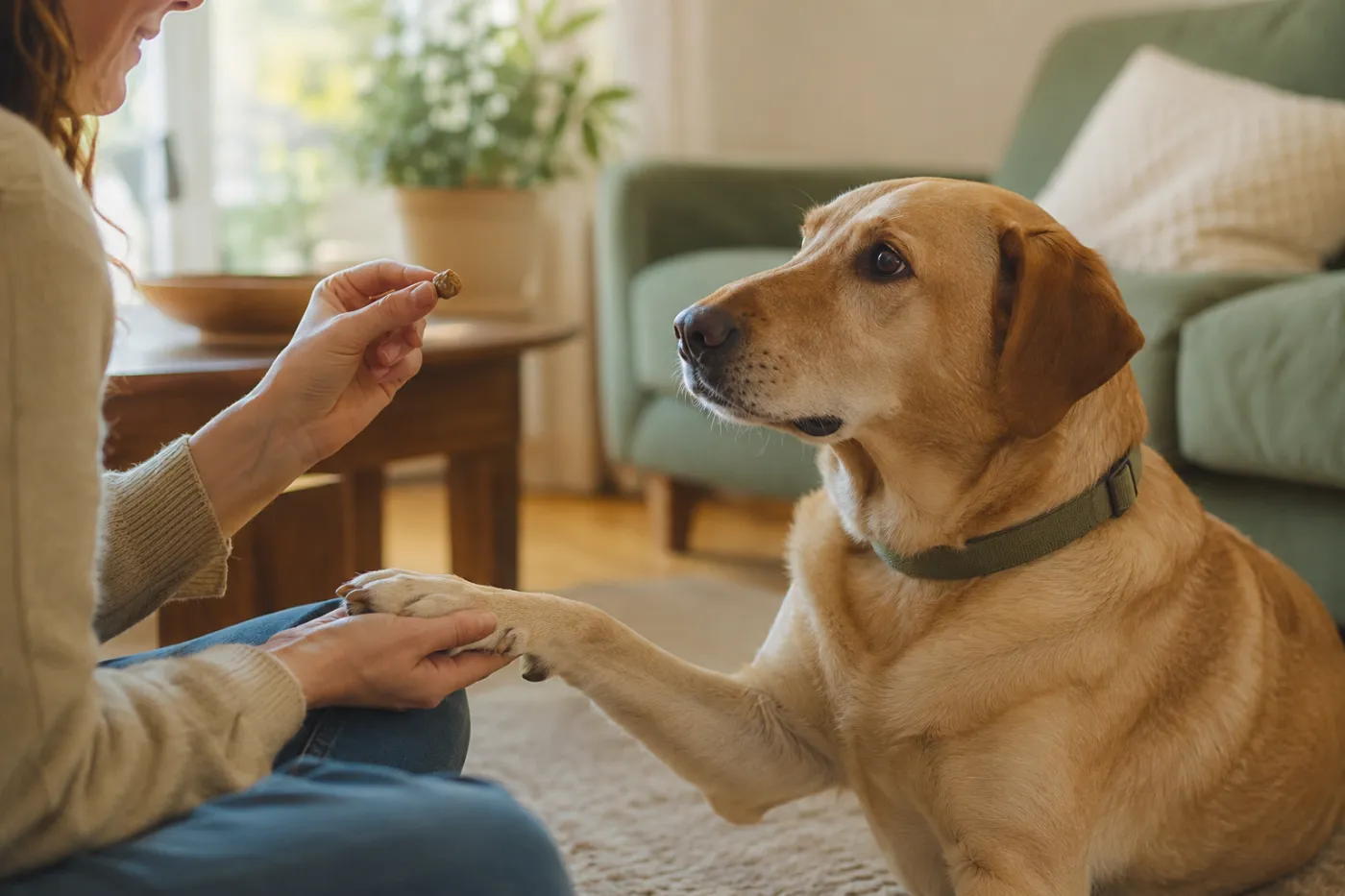
- Paws: rest a finger on a paw for one second, treat, release. Later, lift the paw a centimetre, treat, set it down.
- Ears: touch the base of an ear, treat. Build up to gently lifting the ear flap to peek inside.
- Mouth and muzzle: touch the side of the muzzle, treat. Later, lift a lip briefly to see the teeth, then treat.
- Collar: slip two fingers under the collar, treat, let go. A calm collar-hold is genuinely useful in everyday life.
- Body: run a hand along the back, sides, belly, and tail, treating as you go, so a full-body stroke feels ordinary.
Step 3: add a tiny bit of duration
When a one-second touch is easy, hold for two seconds before treating, then three, and so on. Increase the time in small steps, and drop back a level the moment your dog seems unsure. Always finish a session while your dog is still relaxed and pleased — ending on a good note is what makes them keen to do it again tomorrow.
Everyday health checks
The same handling lets you run gentle, non-diagnostic check-ins: glancing at the paws and nails, peeking inside the ears for redness or smell, looking at the gums and teeth, and feeling along the body for anything new like a lump, a sore spot, or a flinch. You are not diagnosing anything — you are simply noticing changes early so you can mention them to your vet. If any check produces a clear pain reaction, stop and book a veterinary appointment.
A simple starter plan
You do not need long sessions. Spread tiny bits of practice across the week.
- Days 1–3: just the easy spots — chest and shoulders. One-second touch, treat, five reps, twice a day.
- Days 4–7: add one new area (start with whichever your dog tolerates best). Keep touches brief and rewarded.
- Week 2: begin lifting — a paw a centimetre, an ear flap, a lip — always touch-then-treat, always short.
- Week 3 onward: stretch duration gently and string a couple of areas together, like a quick mock health check followed by a jackpot of treats.
When this guide is a good fit
This guide may help if:
- your dog is generally healthy and just a bit fidgety or unsure about being touched in certain places
- you want to prepare a puppy or new dog so future grooming and vet visits go smoothly
- your dog tolerates touch but you would like them to genuinely relax into it
This guide is not enough if:
- your dog growls, snaps, freezes, or panics when touched anywhere — that needs qualified, in-person help
- the dislike of touch appeared suddenly or centres on one spot, which can signal pain
- there is any sign of illness, injury, or a medical issue behind the reaction
Troubleshooting
"My dog pulls their paw away every single time."
You are probably asking for too much, too soon. Drop back to barely brushing the top of the paw with one finger, treat instantly, and build up by tiny increments. If the paw alone is a problem area, spend a few days only working there, at the gentlest possible level.
"My dog takes the treat but still looks tense."
Taking food is not the same as feeling relaxed. Watch the rest of the body — ears, eyes, mouth, posture. If your dog looks stiff or worried, make the touch lighter and shorter, give more space between reps, and consider practising at a quieter time of day.
"How long until this works?"
There is no fixed timeline, and rushing backfires. Some dogs relax in days; others, especially those with a history of being held down, take weeks. Slow, consistent, happy practice almost always beats trying to force quick progress.
"My dog used to be fine with handling and now hates it — what changed?"
A new dislike of being touched, particularly in one area, deserves a vet check before any training. Pain is a common hidden cause, and no amount of treats should be used to push a dog through what might be a sore spot.
What not to do
Do not:
- hold the dog down, pin, scruff, or physically restrain them to "make" them accept touch
- push through fear, flooding the dog with handling in the hope they will get used to it
- use shock, prong, choke, or bark collars, leash corrections, or any "alpha" or dominance methods
- scold, shout at, or startle a dog who pulls away — pulling away is information, not disobedience
- rush the steps, skip ahead, or keep going once your dog signals they have had enough
- ignore growling or freezing — these are warnings, and forcing past them damages trust and can lead to a bite
How this connects to other pages
Gentle handling sits at the heart of cooperative care and kind handling basics, and it is the skill that makes everything in the care cluster possible. Once your dog accepts paw handling, you can build toward nail trims; once they enjoy body touch, you can move on to brushing and grooming and tooth brushing. Comfortable handling also makes vet visits less stressful. A dog who can settle calmly will find all of this easier still.
Educational disclaimer
The information on this page is provided for general educational purposes only. It is not veterinary advice, a behavioural diagnosis, or an individualised training programme, and nothing here has been personally tested on or guaranteed for your dog. Every dog is different, and what suits one may not suit another.
If you have any concern about your dog's health, comfort, or behaviour — especially fear, pain, or aggression around being touched — please consult a veterinarian, a certified positive-reinforcement trainer, a certified behaviour consultant, or a veterinary behaviour professional. When in doubt, stop, give your dog space, and get qualified support.
Sources and further reading
These sources support the humane-training and welfare boundaries used on this page. This page is educational only and is not a substitute for veterinary or qualified behaviour support.