
Get Your Dog Used to Tooth Brushing
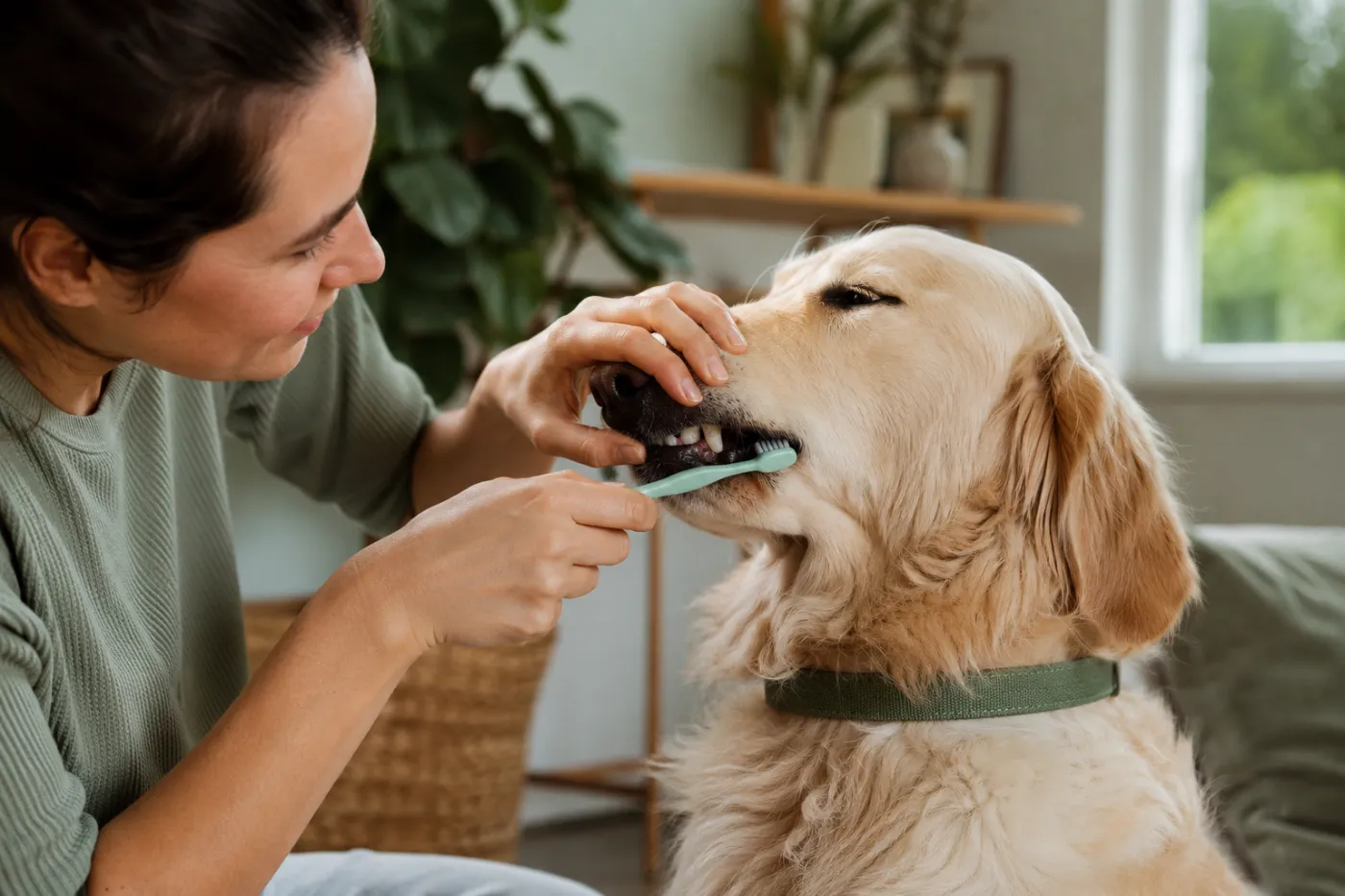
Tooth brushing is one of the small daily habits that supports a dog's everyday oral hygiene. For most dogs it is not something they are born comfortable with — having fingers and a brush near the mouth is unusual, and a dog who has never experienced it has no reason to expect anything good. The aim of this guide is to change that gently, so brushing becomes a calm, predictable part of your routine rather than a wrestling match.
The kindest way to get there is to go slowly and let your dog set the pace. Instead of holding the mouth open and getting the job done, we build the habit in tiny, rewarding stages: a touch here, a lick of paste there, ending while everyone is still relaxed. A dog who feels they can step away whenever they like is a dog who learns to stay. This is cooperative care — the dog opts in, and that consent is what keeps the whole thing low-stress over the long term.
This guide is for ordinary, healthy dogs who simply have not learned that brushing is no big deal. For the reasoning behind the reward-based methods used here, read our humane dog-training principles, and to understand the scope and limits of this site, see what this site covers.
Safety note
This article is educational only. It is not veterinary advice, a diagnosis, or an individualised dental or training plan. Brushing supports oral hygiene at home, but it does not treat, prevent, or cure dental disease, and it is not a replacement for professional dental care.
Use only toothpaste made specifically for dogs. Human toothpaste is not safe for dogs — products meant for people can contain ingredients such as xylitol or fluoride that are not appropriate to swallow, so never substitute them. Brushing is also not a check-up: signs like persistent bad breath, red, swollen, or bleeding gums, broken or loose teeth, heavy drooling, pawing at the mouth, or reluctance to eat all warrant a veterinarian rather than more brushing. If your dog seems sore around the mouth, see signs of pain in dogs; for a wider list of things that mean "stop and get help", read our dog behavior red flags. If handling near the face causes fear, growling, snapping, or panic, stop and get qualified help, as pain is a common hidden cause and a vet should rule it out first.
Build comfort before you build a routine
Brushing has several parts that are all new at once: a hand near the head, lips being lifted, an object in the mouth, and a slightly odd taste. If you introduce them all together, most dogs will pull away. Instead, separate the skill into small pieces and reward each one so your dog learns that every step predicts something good. Keep sessions very short — a minute or two is plenty — and watch your dog's body language throughout.
- Loose, soft body. A relaxed mouth, easy breathing, and a willingness to lean in are signs your dog is happy to carry on.
- Choosing to engage. If your dog stays put and looks for the next treat, they are opting in. That is exactly what you want.
- Signs to pause. Turning the head away, lip-licking, yawning, stiffening, backing off, or "whale eye" (showing the whites) all mean slow down or stop for now.
Pick a calm moment when your dog is already settled, not wound up or hungry to the point of frustration. If your dog finds it hard to relax at all, a separate session on how to teach a dog to settle calmly can make this much easier.
Get used to gentle muzzle and lip handling
Start away from any brush. With one hand, briefly touch the side of your dog's muzzle, then immediately feed a treat with the other hand. Repeat until your dog looks pleased when your hand approaches. Next, gently lift a lip to expose a tooth for a second, then treat. Build up to touching the gums and teeth lightly with a clean finger, always pairing the touch with food and praise. This handling overlaps with our broader guide on how to teach a dog to accept handling, which is worth reading alongside this one.
Let your dog meet the toothpaste
Offer a small smear of dog-safe toothpaste on your finger and let your dog lick it off, as if it were a treat. Many dogs enjoy the flavour, which does a lot of the work for you. Do this on its own for a few sessions so the paste becomes a positive thing in its own right, with no pressure to do anything else.
Introduce the brush itself
Once muzzle handling and paste are both easy, bring in the brush. A soft-bristled dog toothbrush or a finger brush that slips over your fingertip both work well; choose whichever your dog tolerates more readily.
- Let your dog lick paste off the brush. Put a little dog toothpaste on the brush and let your dog lick it, so the brush simply becomes "the thing the tasty paste comes on".
- Touch one or two front teeth. Lift the lip and gently rub the brush over just one or two teeth for a second or two, then reward and stop. Resist the urge to do more.
- Add a few teeth at a time. Over several sessions, include a couple more teeth, focusing on the outer surfaces where your dog can feel them most easily.
- Work towards more of the mouth. Gradually build up to brushing more teeth in gentle circular strokes, always at your dog's pace and always ending before they want to leave.
End every session on a good note, while your dog is still relaxed, with a final treat and some quiet praise. Stopping early is not a failure — it is what keeps your dog willing to come back tomorrow.
A simple starter plan
Days 1-3: handling and paste only
Touch the muzzle, lift a lip, and let your dog lick dog-safe toothpaste off your finger. No brush yet. Two short, happy sessions a day is plenty.
Days 4-7: meet the brush
Let your dog lick paste off the brush, then briefly touch one or two front teeth before rewarding. Keep it under a minute.
Week 2 and beyond: a few teeth, then more
Add a couple of teeth each session as long as your dog stays loose and willing. Folding brushing into a predictable rhythm helps; our simple daily dog-training routine shows how small habits like this can slot into ordinary days.
When this guide is a good fit
This guide may help if:
- your dog is generally healthy and simply unaccustomed to having their mouth handled
- you want to build a calm, voluntary daily hygiene habit without force
- your dog can already accept gentle touch around the head, or is happy to learn
- you are happy to go slowly over days and weeks rather than rushing to a full brush
This guide is not enough if:
- your dog has bad breath, red or bleeding gums, broken or loose teeth, or won't eat — these need a vet
- your dog reacts to mouth handling with fear, growling, snapping, or panic
- there has been a sudden change in behaviour around the mouth or eating
- you are hoping brushing will treat an existing dental problem — it will not
Troubleshooting
"My dog turns their head away as soon as I reach for their mouth."
That is useful information, not stubbornness — your dog is telling you the step is too big. Go back a stage: reward your dog just for letting your hand approach, then for the briefest touch, building back up slowly. The more they can trust that you will stop when they ask, the more they will let you do.
"My dog loves the paste but hates the brush."
Spend longer on the "lick paste off the brush" step so the brush only ever predicts something nice. You can also try a finger brush, which many dogs find less intrusive than a handled toothbrush.
"I can only manage the front teeth — is that pointless?"
Not at all. A few well-tolerated teeth daily, done calmly, is far better than a stressful full-mouth attempt that your dog comes to dread. Coverage will grow naturally as your dog's comfort grows.
"How long should a session last?"
Short and sweet — often under a minute, especially early on. Stopping while your dog is still happy is the single most reliable way to keep them cooperative.
What not to do
Do not:
- hold the mouth shut, pin, scruff, or physically restrain your dog to brush
- use shock, prong, choke, or bark collars, leash corrections, or any "alpha"/dominance approach
- shout at, scold, or startle a dog who pulls away
- flood your dog by pushing through fear or doing the whole mouth before they are ready
- rush the stages or skip ahead because progress feels slow
- use human toothpaste or any product not made specifically for dogs
- treat brushing as a substitute for veterinary dental care or a check-up
How this connects to other pages
Tooth brushing sits within a wider set of calm, consent-based care skills. The foundations are covered in cooperative care and kind handling basics, and the closely related handling work in how to teach a dog to accept handling. If your dog finds grooming generally difficult, our guide to helping a dog enjoy brushing and grooming uses the same gentle, staged approach. The same patience pays off elsewhere too — for example when you get a dog used to nail trims or make vet visits less stressful.
Educational disclaimer
This page offers general, reward-based educational guidance only. It is not veterinary advice, a diagnosis, a dental treatment, or an individualised behaviour plan, and nothing here should be read as a promise of any particular result. Every dog is different, and what suits one may not suit another.
If your dog shows pain, illness or injury, severe fear, panic, aggression, growling or snapping, distress, or a sudden change in behaviour, please consult a veterinarian, a certified positive-reinforcement trainer, a certified behaviour consultant, or a veterinary behaviour professional. If your dog reacts with fear or aggression to handling near the mouth, stop and seek qualified help, as pain is a common hidden cause.
Sources and further reading
These sources support the humane-training and welfare boundaries used on this page. This page is educational only and is not a substitute for veterinary or qualified behavior support.