
Get Your Dog Used to Nail Trims Without Stress
For a lot of dogs, the nail clippers are not a neutral object — they are a warning sign. A paw gets grabbed, something pinches, and the next time the clippers come out the dog is already backing into the next room. Nail care matters for welfare: overgrown nails change how a dog stands and walks, can snag and tear, and in the worst cases curl into the pad. But getting there should never feel like a wrestling match. The goal of this guide is to turn nail trims from something that happens to your dog into something your dog can sit through calmly because they understand it and they have a say.
This is a cooperative-care approach. That means we build the skill in tiny pieces, pair each step with something the dog loves, and let the dog opt in at their own pace. A dog who can choose to stay — and who knows good things happen when the clippers appear — is far easier and safer to handle than one who has learned that paws mean trouble. We are not trying to overpower the fear. We are trying to make it unnecessary.
This guide is for ordinary, healthy dogs whose only problem with nail trims is nervousness or inexperience. For the reasoning behind these methods, read our humane dog-training principles, and to understand the boundaries of what we offer here, see what this site covers.
Safety note
This article is educational only. It is not veterinary advice, a diagnosis, or an individualised care plan.
One practical caution: inside each nail is a sensitive area called the quick, which contains blood vessels and nerves. Avoid cutting into it — take off small amounts only and stop well short. If you nick it and it bleeds, stay calm, apply styptic powder (or a styptic pencil) to stop the bleeding, and contact your vet if it does not settle or if you are unsure. Never keep trimming a paw that is bleeding or that the dog is clearly upset about.
Some signs need a professional rather than a training plan. Limping, lameness, reluctance to bear weight, swollen or painful paws, or any sign your dog is hurting are reasons to see a vet — see signs of pain in dogs. A sudden change in behaviour around handling also warrants a vet check, since pain is a common hidden cause. If your dog reacts to paw handling with real fear, panic, growling, snapping, or aggression, stop and get qualified help from a certified positive-reinforcement trainer or a veterinary behaviour professional rather than pushing on. The dog behaviour red flags page covers when to escalate.
Why so many dogs dread nail trims
It usually is not the nails themselves — it is the package the trimming arrived in. A few common reasons a dog learns to dread it:
- Their paws were grabbed without warning. Paws are sensitive, and a sudden grip feels alarming even before anything happens.
- It hurt once. A single nicked quick can teach a dog to expect pain every time afterwards.
- They felt trapped. Being held still, leaned over, or restrained removes the dog's sense of choice and ramps up the fear.
- The tool itself became scary. If clippers only ever appear right before something unpleasant, the sight or sound of them becomes a trigger on its own.
The fix is to take all of that apart and rebuild it gently, so that paws, the tool, and the sensation each become ordinary and well-paid before they are ever combined.
The plan: rebuild it one small step at a time
Work through these stages in order. Each one should feel easy and relaxed before you move on — if your dog tenses, pulls away, or stops taking treats, you have gone a step too far, so back up to where they were comfortable. Keep sessions short (a minute or two), use treats your dog rarely gets, and always stop while they still want more.
Step 1: Make paw handling pleasant
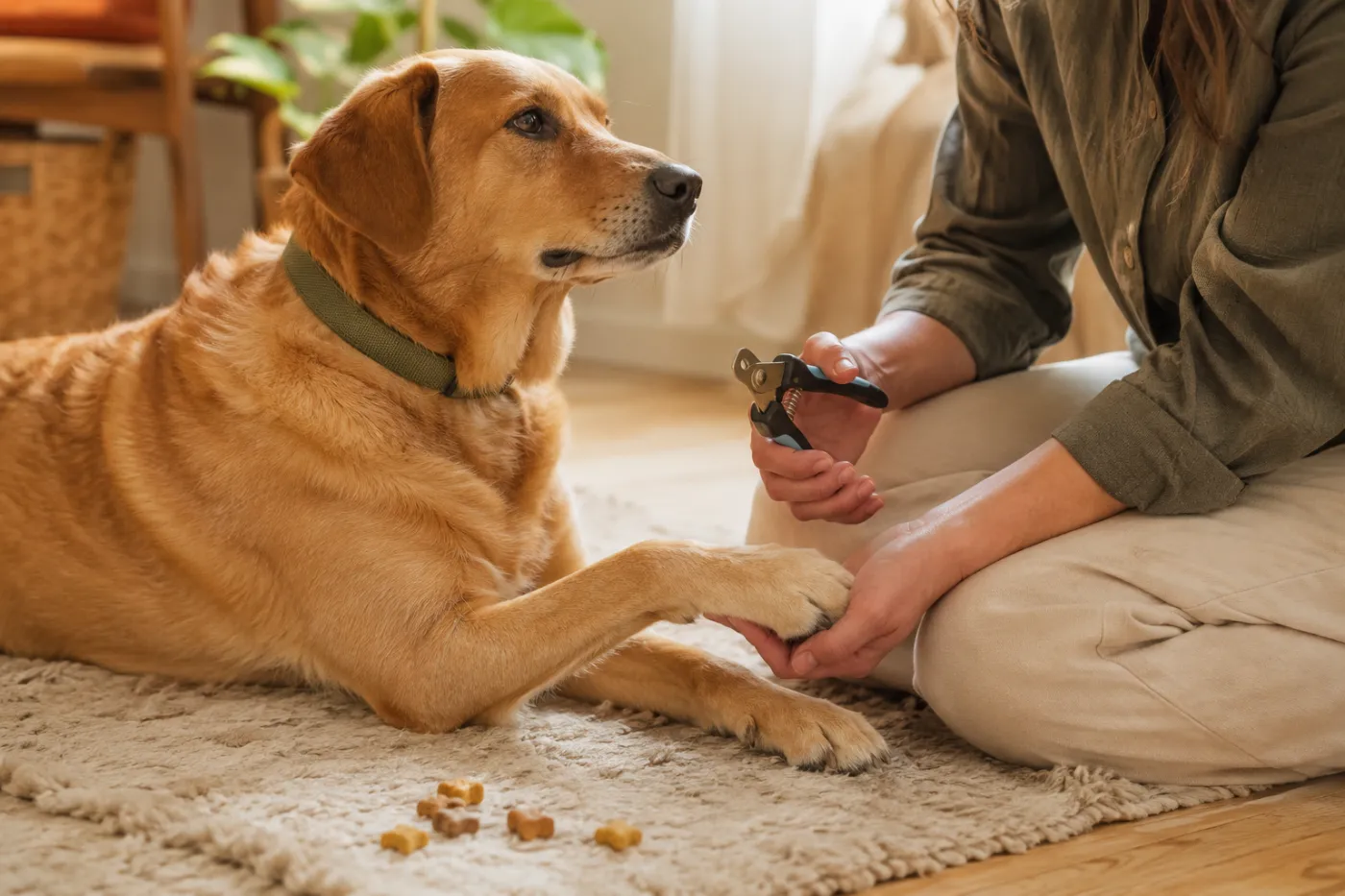
Before any tool appears, teach your dog that having a paw touched predicts good things. Briefly touch a shoulder, then a leg, then a paw — one light touch, then a treat. Build up to gently holding a paw for a second, then releasing and rewarding. Watch the body language: loose body, soft eyes, and leaning in are go signals; stiffening, lip-licking, yawning, or turning away mean slow down.
Step 2: Introduce the tool as a treat-dispenser
Set the clippers or grinder on the floor and let your dog notice them, then drop a treat. Pick the tool up, treat; put it down, treat. If you are using a grinder, let your dog hear it running at a distance and pair the sound with food. The aim is for the tool to predict snacks, not pinching.
Step 3: Touch nail with the tool — no cutting
Hold a paw, touch the clippers (closed) or the switched-off grinder to a single nail, then treat and release. Repeat across different nails over several short sessions until the contact is a complete non-event.
Step 4: One nail, then end
When your dog is relaxed with contact, trim a single tiny sliver off one nail — then immediately reward generously and stop the session entirely. One nail and a jackpot teaches your dog that trimming is brief and worth it.
Step 5: Build up to more
Add one or two more nails per session over days, never racing to finish all four paws at once. It is completely fine to do one paw today and another tomorrow. Going slowly and ending early is the strategy, not a sign you are behind.
Clippers or grinder?
Both can work well — this is your call. Clippers are quick and quiet; some dogs prefer them. Grinders file the nail down gradually and avoid the sudden snap, but the noise and vibration take their own getting-used-to. Whichever you choose, introduce it the same patient way, and feel free to switch if your dog clearly prefers one over the other.
A simple starter plan
Week 1: paws and tool, no trimming
Do a couple of one-minute sessions a day on paw touches (Step 1) and letting the tool predict treats (Step 2). No nails get cut this week. You are just building a happy association.
Week 2: contact and a first nail
Move on to touching nails with the tool (Step 3). Once that is easy, attempt a single nail (Step 4) and stop. Celebrate it.
Ongoing: little and often
Trim a few nails at a time on a regular, low-pressure schedule. Frequent tiny sessions keep nails in check and keep the whole thing boring — which is exactly what you want.
When this guide is a good fit
This guide may help if:
- your dog is healthy but nervous, fidgety, or simply new to nail trims
- your dog pulls their paw away or wanders off but does not panic or threaten to bite
- you have time to go slowly and are happy to do one paw — or one nail — at a time
This guide is not enough if:
- your dog is limping, sore, or showing any sign of pain — see a vet first
- your dog reacts to paw handling with panic, freezing, growling, snapping, or aggression
- nails are already overgrown, curling, or causing problems and need professional attention now
Troubleshooting
"My dog snatches their paw away the moment I touch it."
You are likely starting closer to the paw than they are ready for. Drop back to touching a shoulder or upper leg, pay well, and creep towards the paw over several sessions. Let them keep the choice to move — a dog who is not pinned learns to relax much faster.
"I accidentally cut the quick and now they run from the clippers."
That is a normal reaction, and it is fixable. Put trimming aside for a while and go right back to Step 1 and 2 so the tool becomes a treat-predictor again before any nail is touched. Take even smaller slivers next time, and keep styptic powder on hand for peace of mind.
"They are fine for one nail, then get fed up."
Then one nail is your session for now. End on that good note rather than pushing for a second and souring the mood. You can always do more later in the day or tomorrow; spreading it out is the plan working, not failing.
"It is taking weeks and I feel like I am barely getting anywhere."
Slow is the point. Every calm, well-paid session is deposit in the bank — your dog is learning that nails are safe and predictable. That foundation lasts far longer than any rushed, stressful trim ever would.
What not to do
Do not:
- hold the dog down, pin them, scruff them, or restrain a struggling paw
- shout, scold, smack, or startle the dog for pulling away or wriggling
- use shock, prong, choke, or bark collars, leash corrections, or any "alpha" or dominance tactics
- rush through every nail in one go, or push past clear signs of fear (flooding)
- cut into the quick or keep trimming a paw that is bleeding or that the dog is upset about
- force a terrified or aggressive dog through it — stop and get qualified, force-free help instead
How this connects to other pages
Nail trims are one piece of a wider toolkit. The same gentle, opt-in approach underpins cooperative care and kind handling basics, and it builds directly on teaching your dog to accept gentle handling. Once paws feel safe, you can apply the same method to brushing and grooming and to making vet visits less stressful. A dog who can settle calmly will find the whole process easier, too.
Educational disclaimer
The information on this page is for general educational purposes only. It is not veterinary advice, a behavioural diagnosis, or a personalised plan for your individual dog, and nothing here has been personally tested on or guaranteed for your situation.
If your dog shows pain, lameness, sudden behaviour change, severe fear, panic, or any aggression around handling, stop and consult a vet, a certified positive-reinforcement trainer, a certified behaviour consultant, or a veterinary behaviour professional. Pain is a common hidden cause of handling problems, and getting it checked is always the kind choice.
Sources and further reading
These sources support the humane-training and welfare boundaries used on this page. This page is educational only and is not a substitute for veterinary or qualified behaviour support.