
Teaching a Dog to Greet Guests Politely
The doorbell rings, and suddenly your calm dog turns into a bouncing, barking whirlwind. For many friendly dogs, visitors are simply the most exciting thing that can possibly happen — so they throw everything they have at the moment a guest arrives. The aim of this guide is not to stop your dog from being pleased to see people. It is to help that excitement land politely, with four feet on the floor, so greetings stay fun for everyone and safe for small guests.
Polite greetings are a skill you teach, not a manner your dog should already know. A dog who jumps, mouths, or spins at the door has usually been accidentally rewarded for it — by attention, by the visitor's reaction, or simply by the thrill of arrival. We change that picture by setting the dog up to succeed and rewarding the calm version instead. For the reasoning behind this reward-based approach, read humane dog-training principles, and for what this site does and does not cover, read what this dog-training site covers.
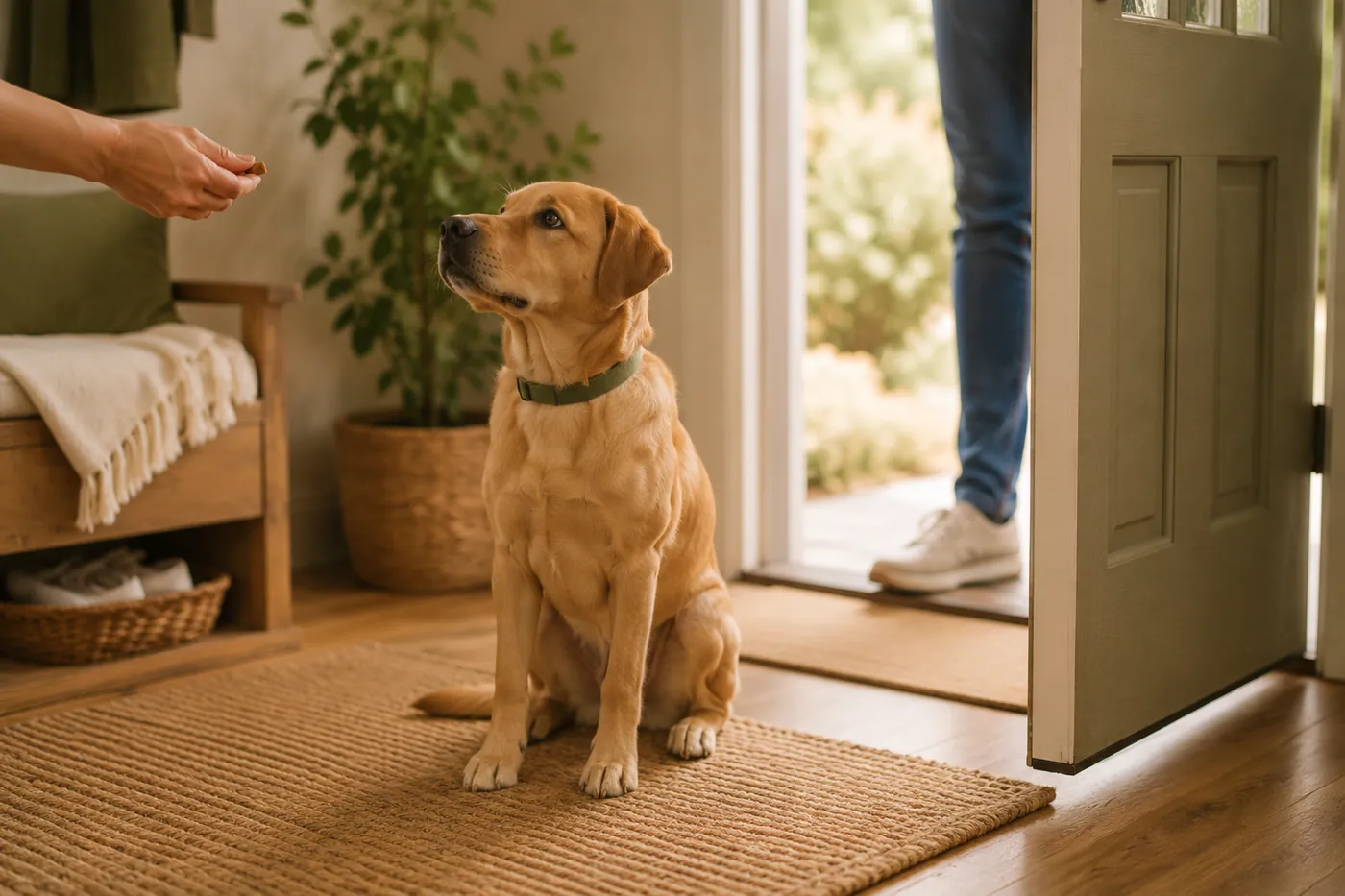
Safety note
This article is educational only. It is not veterinary advice, a diagnosis, or an individualized training plan.
This guide is written for ordinary, friendly over-excitement at the door — the wiggly, happy dog who just wants to say hello. It is not for dogs who are fearful of visitors, who guard people, food, toys, or space, who growl, freeze, snap, lunge, or show any aggression when people arrive. Those signs mean the dog is not comfortable, and pushing them to greet can be dangerous. If any of this sounds like your dog, please stop and read dog behavior red flags and seek a qualified positive-reinforcement behavior professional rather than continuing on your own. Because greetings involve people getting close to a dog's mouth, it is also worth knowing the basics of dog-bite prevention from the AVMA.
Children and dogs need extra care. A child should never be put in charge of managing the dog at the door, holding the leash, or deciding when the dog may greet. Even a friendly dog can knock a small child over by accident. Keep children and dogs supervised at close quarters by an adult at all times during greetings.
When this guide is a good fit
This guide may help if:
- your dog is friendly and simply over-excited when people arrive
- your dog jumps up, spins, or bounces at the door out of happiness
- you want a calm routine you can use every time the doorbell rings
- you would like visitors to be able to enter without being mobbed.
This guide is not enough if:
- your dog is fearful, anxious, or hides when visitors come
- your dog growls, freezes, stares hard, snaps, or lunges at people
- your dog guards you, the doorway, food, toys, or resting places
- greetings have already involved a bite, a near-bite, or contact that frightened someone.
In those situations, stop working on greetings independently and get help. Aggression, fear, and guarding around visitors are exactly the kind of issue covered in dog behavior red flags, and they call for a veterinarian or a qualified positive-reinforcement behavior professional, not more door drills.
Why dogs greet so wildly
Jumping up is, at its root, a social greeting. Dogs naturally aim for the face, and standing on their back legs gets them closer. Add the build-up of the doorbell, the sound of voices, and a guest who leans in saying "hello!" in a high, happy voice, and you have a recipe for full-body excitement. The dog is not being dominant or rude — they are simply doing what has worked before to get attention and contact.
The practical takeaway is that we want to make the calm choice the rewarding one, and to lower the overall excitement so the dog can actually think. Punishing the jump — kneeing, shouting, grabbing, or using any corrective device — tends to backfire: it adds tension to an already over-aroused moment, can frighten the dog, and often does nothing to teach what you would like instead.
The reward-based method: Manage, Job, Reward
A simple way to remember the whole plan is three words:
- Manage — use a leash, a gate, or a closed door so the dog physically cannot rehearse jumping.
- Job — give the dog something clear to do, such as going to a mat or station, instead of leaving them to invent their own greeting.
- Reward — pay generously for four feet on the floor and calm behavior, and let a polite greeting be part of the reward.
Manage: set up so jumping cannot be practiced
Every time a dog jumps on a guest and gets a reaction, the habit gets stronger. Management breaks that loop while the dog is still learning.
- Keep a leash by the door so you can calmly clip it on before opening up, giving you gentle control without any yanking or correcting.
- Use a baby gate or an exercise pen so the dog can see and hear the guest but cannot launch at them.
- For a very excited dog, let the guest come fully inside and settle first, then bring the dog in once the initial fizz has passed.
Job: teach "go to your mat"
A dog who has a clear job is far easier than a dog left to guess. Sending your dog to a mat, bed, or specific spot gives them a calm, rewardable thing to do when the doorbell rings.
- Away from any doorbell excitement, toss a treat onto the mat and mark the moment your dog steps on it with a warm "yes" or a click.
- Reward repeatedly for staying on the mat, feeding low and calm so the dog learns that the mat pays well.
- Add a cue such as "place" or "bed" once the dog is reliably heading there on their own.
- Practise sending the dog to the mat from further away, and for longer, before you ever pair it with a real visitor.
Teaching a settled position underpins all of this. The companion guide on how to teach a dog to settle calmly walks through building that relaxed off-switch, which is the foundation of a polite greeting.
Reward: pay for four on the floor
The behavior you reward is the behavior you get more of, so be deliberate about catching the calm version.
- Reward your dog the instant all four feet are on the floor — calm standing, sitting, or staying on the mat all count.
- If your dog leaps up, simply remove the reward and the attention for a moment: turn slightly, step back, and wait. The fun resumes the moment they are grounded again.
- Let the greeting itself be a reward. Calm dog, hello happens; bouncing dog, the hello quietly pauses.
Prepare your visitors
Half of polite greetings come down to the human on the other side of the door. Excited visitors create excited dogs, so brief your guests before they arrive or as they come in.
- Ask them to keep their voice calm and their movements low-key rather than squealing and leaning in.
- Ask them to ignore the dog at first — no eye contact, no reaching, no "who's a good boy" — until the dog has settled.
- Explain that they should only greet the dog once all four feet are on the floor, and that a jumping dog gets a calm turn of the back, not a telling-off.
- Make clear that it is fine if the dog does not greet them at all. Not every dog wants to meet every visitor, and that choice should always be respected.
It helps enormously to keep a small pot of treats by the door so you, or a calm adult guest, can reward the right behavior in the moment instead of scrambling for rewards too late.
A simple starter plan
Step 1: practise with no real guest
Ring or knock yourself, or have a household member do it, while you reward your dog for going to the mat or keeping four on the floor. Repeat until the doorbell predicts "go to my spot" rather than "explode."
Step 2: rehearse with a calm helper
Ask a patient friend to play the guest. Have them enter slowly, ignore the dog, and wait. You manage the leash or gate and reward calm. Keep the sessions short and end while the dog is still relaxed.
Step 3: allow a calm greeting
Once the dog can stay grounded, let the helper offer a quiet hello while the dog has four feet down. If the dog pops up, the greeting calmly pauses and resets. Calm earns contact; over-excitement gently ends it.
Step 4: generalise to real visits
Bring the routine into ordinary visits, using management for any guest who cannot follow the brief, such as young children or very excitable friends. Drop the leash and gate gradually, only as the dog proves they can stay polite without them.
Troubleshooting
"My dog is calm with me practising, but loses it with real guests."
Real visitors are far more exciting than rehearsals, so expect to go back a step. Use the leash or gate again, keep rewards flowing, and let the guest settle before any greeting. Excitement that high usually means the dog is over the threshold where they can think, so lower the intensity rather than pushing through it.
"My dog jumps the moment the door opens, before I can do anything."
Then the door opening is happening too soon. Clip the leash on first, or send the dog to their mat before you touch the handle. If that is not realistic, gate the dog in another room and let them join once the guest is seated and calm.
"Should I ask my dog to sit for every greeting?"
A sit can help, but four feet on the floor is the real goal — a dog standing calmly is greeting politely too. Insisting on a perfect sit in a high-excitement moment can set the dog up to fail. Reward calm in whatever grounded shape it takes.
"My dog barks at the door as well as jumping."
Doorbell barking often travels with greeting excitement. The same calm setup helps, and the dedicated guide on barking at noises, visitors, and triggers covers it in more depth. If the barking is more about seeking attention, see reducing attention-seeking barking.
"Can my children practise this with the dog?"
No — leave management and greetings to an adult. Children can be part of a calm household and can quietly toss a treat under close adult supervision, but they should never hold the leash, control the door, or be responsible for the dog's behavior. Supervise every interaction between children and dogs at the door.
What not to do
Do not:
- knee, push, grab, or step on the dog to stop jumping
- shout, scold, or startle the dog at the door
- use shock, prong, or choke collars, or any leash corrections, to "fix" greetings
- rely on dominance or "alpha" explanations for the behavior
- force a reluctant or worried dog to greet anyone
- let a child manage, restrain, or be left alone with the dog during greetings.
Punishment at the door adds stress to an already over-aroused moment. It can turn happy excitement into anxiety about visitors, which is far harder to live with than a few enthusiastic jumps.
How this connects to other pages
Polite greetings sit alongside a handful of related skills. Calm hellos are much easier once your dog can settle calmly on a mat, and the same four-on-the-floor thinking runs through the guide to stopping a dog jumping without punishment. If the doorbell sets off barking, see barking at noises and visitors, and if the door itself is a dash risk, read stopping door-dashing. Building all of this into a simple daily training routine keeps the skills fresh. And if your dog is ever fearful, guarding, or aggressive with visitors, stop and check the dog behavior red flags for the professional-help path.
Educational disclaimer
This page provides general educational information about teaching ordinary, friendly dogs to greet visitors calmly. It is not veterinary advice, a diagnosis, or an individualized behavior plan.
If your dog is fearful of visitors, guards people or resources, growls, freezes, snaps, lunges, or has shown any aggression, or if greetings have ever involved a bite or near-bite, contact an appropriate professional such as a veterinarian or a qualified positive-reinforcement behavior professional. Always supervise children and dogs together, and never leave a child responsible for managing the dog.
Sources and further reading
These sources support the humane-training and welfare boundaries used on this page. This page is educational only and is not a substitute for veterinary or qualified behavior support.